
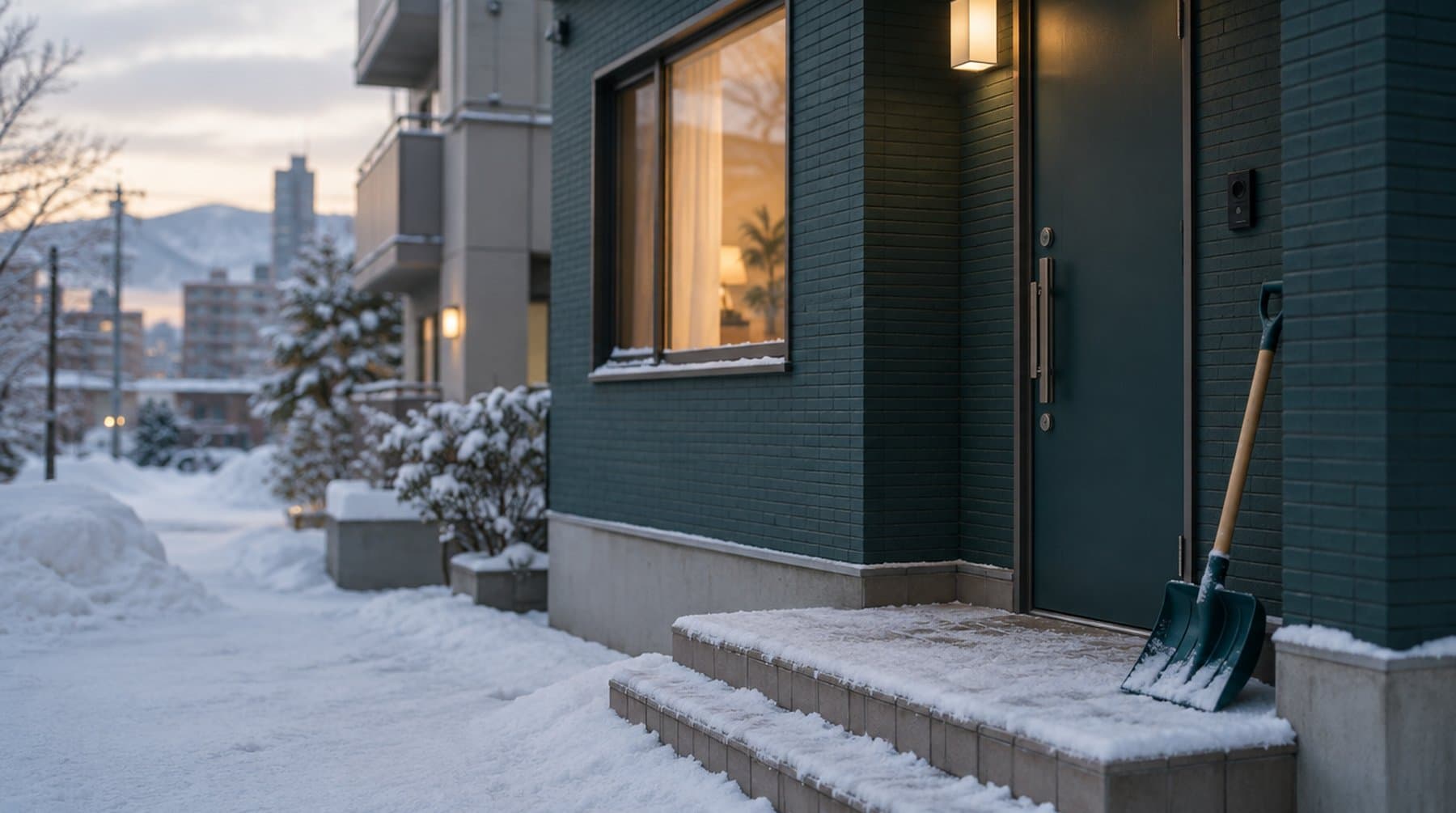
We run three apartments (SAPPORO NORTH) in Kita ward, Sapporo, four minutes on foot from a subway station, on a hotel-business permit (旅館業許可, the Japanese licence with no annual cap on nights; ours is 札保生許可(旅)第64号). Same company and same manuals as our three Tokyo rooms, which is what makes the comparison below worth anything.
The conclusion first. What decides a snow-country winter is not effort in February, it is preparation in November, and November was the weakest month of the year across our Sapporo rooms (twelve months from August 2025, measured 21 August 2026, operating data). The winter bill lands in the month with the thinnest revenue behind it.
When does the Sapporo winter season start and stop?
In our rooms it starts in December and ends in March, with November and April falling away sharply on either side. Put the same twelve months beside our Tokyo rooms and the shapes are not the same business (measured 21 August 2026, operating data).
| Month | Sapporo, 3 rooms | Tokyo, 3 rooms |
|---|---|---|
| October 2025 | 80.6% | 95.2% |
| November 2025 | 68.3% | 93.3% |
| December 2025 | 87.1% | 78.5% |
| January 2026 | 83.9% | 80.6% |
| February 2026 | 94.0% | 84.5% |
| March 2026 | 90.3% | 84.9% |
| April 2026 | 71.1% | 90.0% |
December to March averages 88.8% against 78.6% across the other eight months, a ten-point gap. But the year's high (94.0% in February) and its low (68.3% in November) sit 25.7 points apart, and a winter plan has to stand on that range rather than on the average. In that same November our Tokyo rooms ran 93.3%: one company, one month, twenty-five points apart. These are our own results, not a level we would predict for another property.
What work does winter actually add?
Five things, and four of them are not cleaning.
- Snow clearing: the entrance and path a guest walks, cleared by the morning after it falls. It is triggered by snowfall, not by the turnover calendar, so it lands on days nobody was going to the property anyway
- Heating checks: a guest walking into a cold room forms an impression you cannot recover, so the room is warm before arrival rather than after
- Freeze management: for a room sitting empty between bookings, either drain the water lines or hold a minimum temperature
- A winter edition of the guest notes: pavement, footwear, how the heating is operated, and how rubbish works when the collection point is under snow
- Entrance consumables: mats, grip, de-icer. This is the part of consumables (4.2% of revenue across our twelve months) that swells in winter
Of the five, snow clearing is the one that is never in a cleaning contractor's standard quote. Put who does it, and by when, into writing before signing. And where snow taken off a property may be put varies by municipality and is revised, so confirm it for that address with the ward or city office rather than taking a neighbour's word for it.
Who should do the snow clearing?
The answer is not a type of contractor. It is whether the arrangement finishes the job by the morning after a snowfall.
| Arrangement | Works when | Where it breaks |
|---|---|---|
| The owner | You live in the city and can move on a snowfall morning | A trip or a bad back becomes a gap in the service |
| Cleaning team, snow included | One contact covers both turnover and snow | Snowfall days and cleaning days do not line up, so it needs its own pricing line |
| A dedicated snow contractor | Wide frontage or parking, where machinery is needed | Hard to engage for one small entrance path |
Prices move too much with district and frontage for a single market number to be honest here. Ask three things and the quotes become comparable: what triggers a callout (how many centimetres), what area is covered (entrance only, or path and parking too), and what happens to the snow once it has been moved. A quote missing any of the three is cheaper-looking rather than cheaper.
Where does winter heating show up in the P/L?
Across our twelve months, electricity took 2.6% of revenue and gas 1.0% (measured 21 August 2026, operating data).
Two caveats travel with that, and both are on the data page. It is the twelve-month average across all six rooms including Tokyo, not a Sapporo-winter figure. And water is billed every two months and tracked outside that workbook, so it is absent rather than zero, which makes the real total heavier than the sum shown.
So do not carry our percentage across to a property you are weighing. Split the estimate by how the building heats: central heating for the whole block, or per-room air conditioners and panel heaters. The two differ in cost and in how a guest experiences the room, and you can establish which one you are looking at during the viewing.
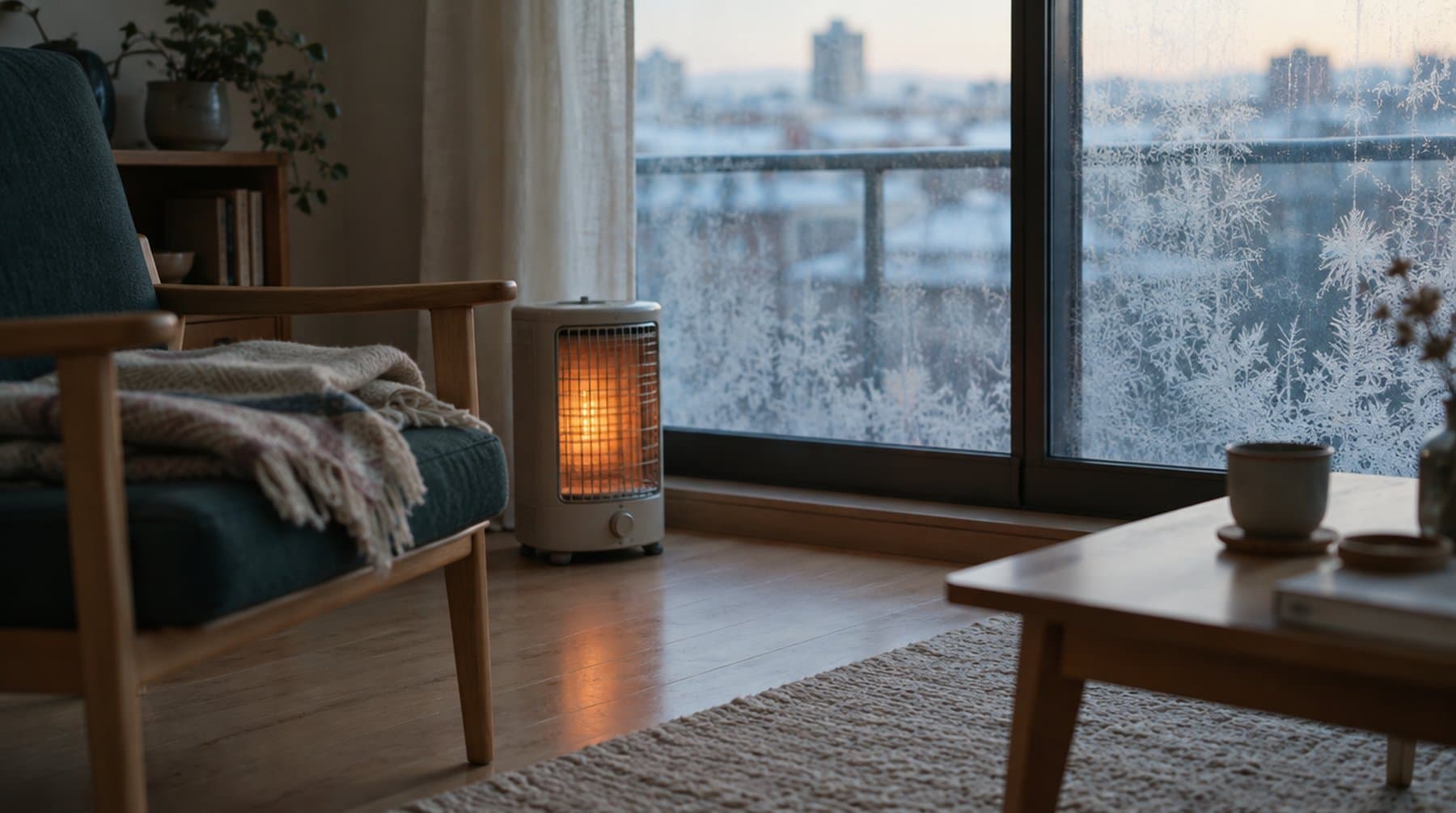
What does a freeze cost when it goes wrong?
The expensive failure is burst pipework in a room that sat empty, because the repair is only the first bill: the bookings behind it go too. Our repairs line sits at 1.1% of revenue over twelve months (operating data), and it holds only because nothing has burst. The order we work in:
- As soon as a gap in the calendar is visible, decide per room: drain the lines, or hold minimum heat
- Where you hold heat, do not set it too low. Saving on electricity and losing the pipework is the most expensive trade available in January
- Check water and heating by eye at every cleaning turnover. In winter the turnover doubles as the inspection
- After a long vacancy, send a person in to run the water and the heating before the next guest arrives, not with them
What do guests get wrong in winter?
Three things, all on the first night: the pavement, their shoes, and the heating controls. Most guests have never walked on ice. Our notes swap the station directions for photographs taken in winter, put the footwear warning before the route rather than after it, and show the heating controls as photographs of the actual unit. The midnight message saying the heating is broken is usually neither a breaker nor a fault; it is a control panel in Japanese that nobody could read.
The single piece of equipment that earned most in winter is the washer-dryer: whether the things that got soaked are dry by morning changes the stay rather than decorates it. We hold 364 reviews at a weighted 4.9 across all listings (measured 21 August 2026), and the winter ones concentrate on two things, how warm the room was and what the footing was like at the door.
When should winter preparation start?
Finish it during October; starting in November is starting late. Two reasons. First, occupancy: November was our Sapporo rooms' weakest month at 68.3%, so the month that looks free of guests is the month with the least revenue to pay for the preparation. Second, how bookings arrive: our median booking lands 42 days before check-in (449 bookings over twelve months), which means December-to-February stays are largely sold between October and December. By the time it is snowing, the winter's revenue has already been decided.
- September: choose who clears the snow, and put the callout trigger and the covered area into the contract
- October: test heating and hot water, update the winter edition of the guest notes, replace entrance consumables
- November: before the first snow, walk the route from the street to the room the way a guest walks it
- December to March: clearing on snowfall days, freeze management on empty rooms
Can a Tokyo-based company run a Sapporo winter?
Judge it on whether the people who clear the snow are in that city, not on where the office is.
We take Sapporo properties because our own three rooms, our cleaning team and our snow arrangements are already there. The cases where hiring us is the wrong call, said plainly: if you live in Sapporo and can move on every snowfall morning, running your own winter is faster and cheaper than paying us to do it; if your building's management association already clears the grounds, one of the things we bring is redundant before we start; and we work in Tokyo's 23 wards and Sapporo only, so a property in any other snow-country city is one we will decline.
The structure of the monthly numbers is in reading a monthly P/L, and the market and licensing side of Sapporo is in starting a rental in Sapporo.
Ask about a Sapporo property