
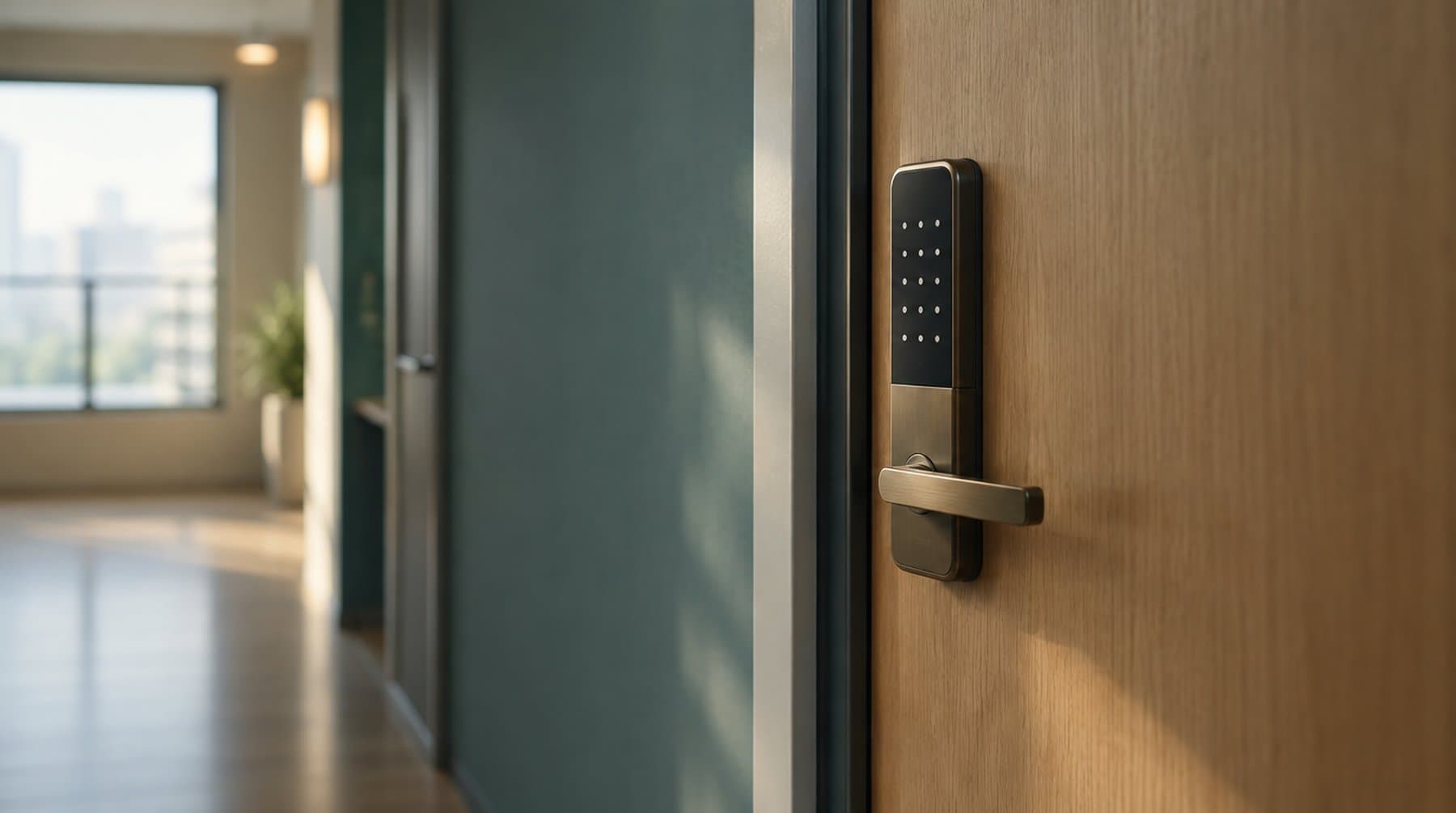
Key handover is an operating design, not a hardware purchase. We run three buildings and six rooms in Ota and Katsushika in Tokyo and Kita ward in Sapporo, all on hotel-business permits, and all six are unattended self check-in (figures published on our operating data page). At an average stay of 3.3 nights and 449 bookings over twelve months, each room is opened by somebody who has never seen the door about seven times a month (measured August 2026, for the twelve months to July 2026).
Across those six rooms, guests get in three different ways. The same company, running to the same idea, did not end up with one method, and that is where this article starts.
How do we actually hand over keys?
All three buildings are unattended, and all three use different hardware. Sapporo has a keypad on the room door, Heiwajima has a dial mailbox holding the entrance key plus a keypad upstairs, Kameari has a dial key box by the door holding a card key.
Every one of these is published with photographs in the guest manual. The codes are not. Codes go only into the message sent for that booking, and that line holds regardless of which method the building uses.
| Building | Entrance | Room door | Returned at checkout |
|---|---|---|---|
| SAPPORO NORTH (3 rooms) | Shared building entrance | Code on a keypad | Nothing |
| HEIWAJIMA (1 room) | Key inside a dial mailbox | Code on a keypad | Entrance key back in the mailbox |
| KAMEARI (2 rooms) | Shared building entrance | Card key from a dial key box, held to the sensor | Card key back in the key box |
Why do three buildings need three methods?
Because the building decides, not the operator. The existing door, the existing lock, whether the entrance is shared, and how far you are allowed to alter the fabric between them close off most of the options before anybody has an opinion.
The Heiwajima entrance key sits in a mailbox because that door is the shared entrance to the building and we cannot change its lock on our own say-so. Kameari uses a card because the door hardware reads a card. Sapporo is uniform across three rooms because we run the whole building and the conditions are the same on every floor.
So a management company that promises smart locks before seeing the property has either not looked or will revise it later. The order runs the other way: look at the door, then choose.
Is a smart lock enough on its own?
No, because key handover is not one door. It is three layers: the building entrance, the room door, and the route out of a failure.
A smart lock solves the middle layer. If the entrance is shared and mechanical, that outer layer needs its own answer, and at Heiwajima the most primitive component in the whole system, a mailbox with a rotating dial, is the one carrying it.
The third layer, the failure route, cannot be bought. Outside the Sapporo doors there is a RING device with a blue button that reaches us directly. Half the reason for 24-hour first response is this: somebody stuck in front of a door does not need another machine, they need an answer.
What actually breaks?
People and numbers break far more often than hardware. In order of frequency: mistyped codes, instructions that were never read, codes mixed up between units in the same building, and batteries.
Mistyping is punished by design. Both the Sapporo and Heiwajima keypads lock after five wrong codes in a row, which is why the guest instructions carry that warning in plain words. A guest arriving late and getting it wrong four times in a hurry is inside the expected operating range.
| What happens | How it looks at the door | What closes it |
|---|---|---|
| Mistyped code | Keypad locks after five tries | Warning in the instructions, response that talks them through |
| Instructions not read | Guest cannot find the code at all | Pre-arrival message and photo steps in four languages |
| Codes mixed between units | Entering the neighbour's code | Per-booking message naming the room |
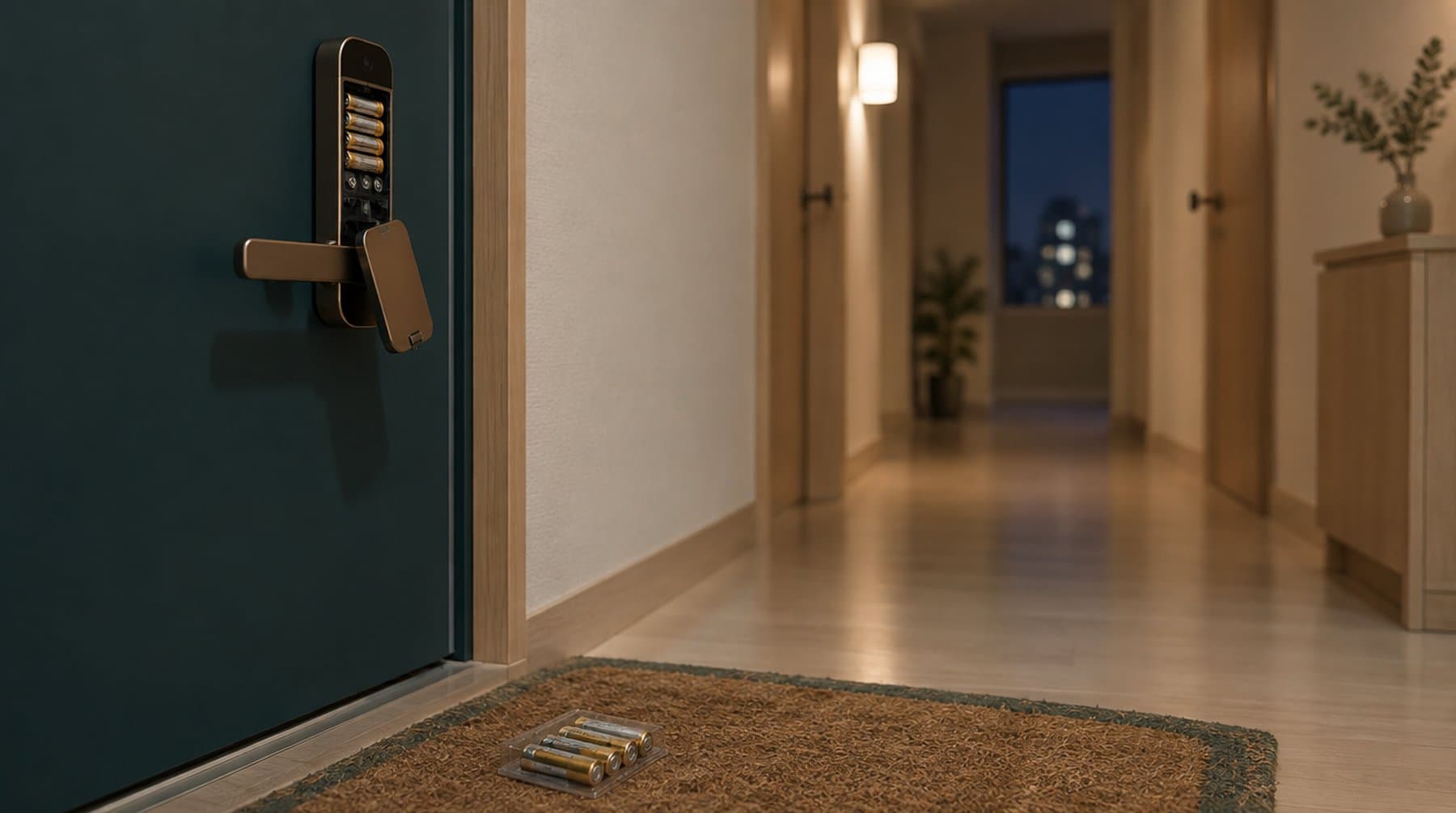
| Battery | No response, no beep | Scheduled replacement plus a route that does not depend on the device |
| Key not returned | Empty mailbox after checkout | Stated in the checkout note, checked at the clean |
A battery dies at midnight. Who moves?
It comes down to whether anybody can physically reach that door, which is the largest real difference between running it yourself and hiring somebody, and it has nothing to do with the hardware.
Two things make it survivable. A physical route into the room that does not depend on the code, and a person within reach of it. In our case the regular visit is the cleaning turnover, seven to eight times a month per room, so somebody touches the door often without inventing an inspection round for it.
As a cost line this is small: maintenance runs 1.1% of revenue against cleaning at 17.5% (measured August 2026, operating data). We treat it as the cheap line that can stop everything else, rather than the cheap line that can wait.
What language do the instructions need to be in?
Photographed steps in four languages, with the code kept off every public page. The code goes only into the message for that booking.
Our guest manual runs in Japanese, English, Chinese and Korean, and it shows the door, the keypad and the mailbox as pictures. That is not translation for its own sake. A person standing in front of a door at night does not read prose, they look for a picture and a number.
It shows up in the reviews too: 364 reviews at 4.9 (measured August 2026, operating data). A night somebody could not get in weighs differently from a complaint about cleaning or a missing appliance.
How does this connect to the permit conditions?
Whether a property can be run unattended is decided by its permit conditions, not by the specification of the lock, and this is not a place for a general rule.
How guests are identified, what is required in place of a staffed front desk, and how quickly a person has to be able to reach the property in an emergency are handled differently depending on the municipality and the classification of the facility. Confirm both with the health centre and the fire department covering the property. The wider sequence is in getting a hotel-business permit.
One practical rule does generalise: buy the lock after you have heard the conditions. Do it the other way round and the hardware gets ripped out again.
What changes if a management company handles it?
Not the hardware. What changes is how long a guest stands in front of a door at midnight before a person answers.
Three things are worth pinning down before signing. Who issues the codes and when they change. How many minutes it takes for a cannot-get-in message to reach a human, and who physically goes. And who owns the locks and the keys, so you know what is left when the contract ends. The third is the one people forget, and it belongs in the same conversation as what management actually costs.
We run three methods across six rooms and are not trying to unify them. The point was never one method, it was the same response behind all of them.