
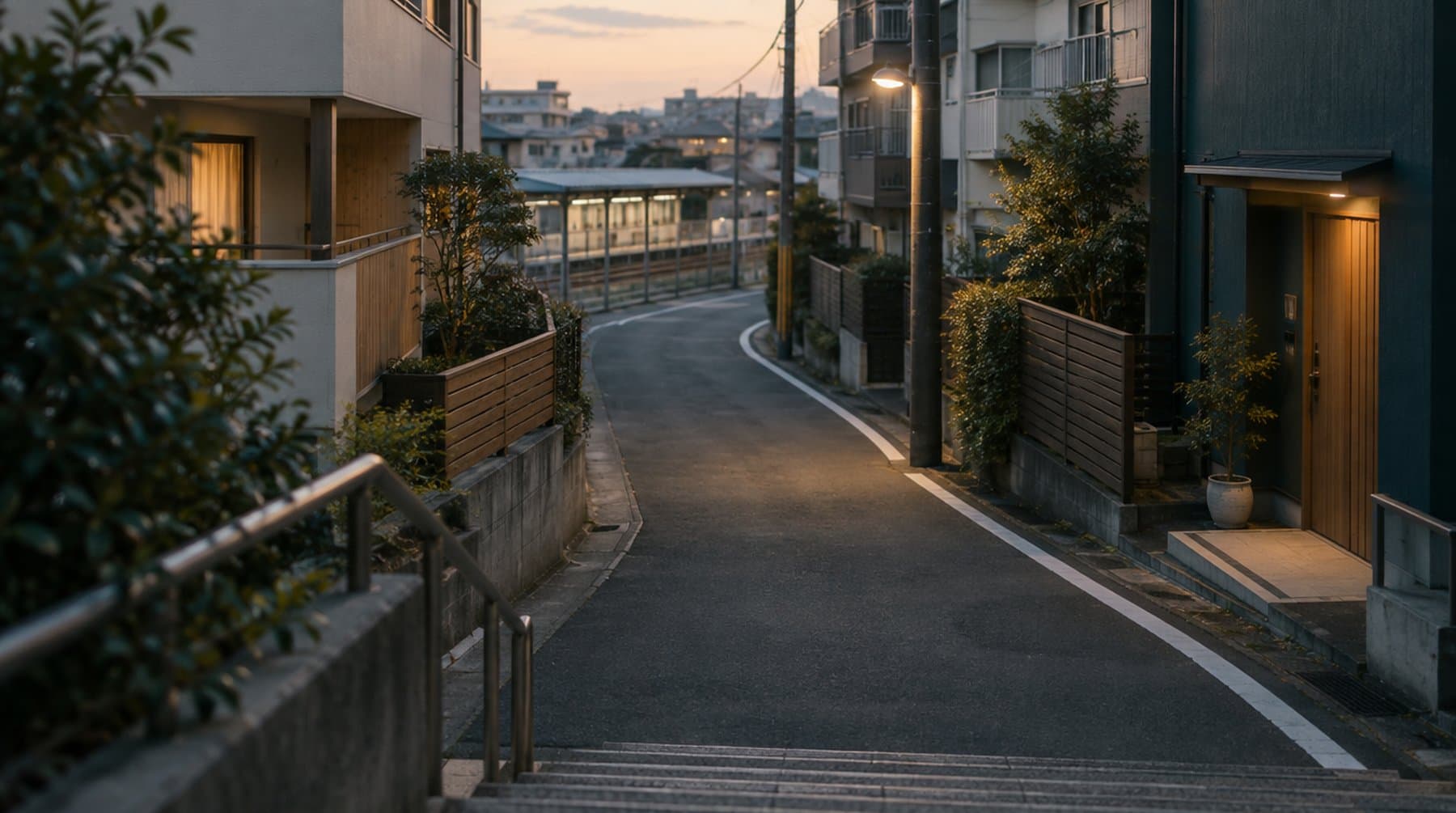
Our line is a ten-minute walk. Past that we turn properties down, sometimes good ones. Our three buildings and six rooms stand 30 seconds on foot from Heiwajima station, 4 minutes from Kameari and 4 minutes from Kita-18-jo, all of them inside four minutes, and that is not a coincidence. Layout, furniture and appliances can all be fixed later with money. The walk to the station is the one thing that cannot be fixed after you have bought.
This is not a table of local rules: such a table is out of date the day it is written. The figures below are as of August 2026, from our own three buildings and six rooms over the twelve months from August 2025 to July 2026, with the method on our operating data page. Reviews are as of September 2026 and the transit times are those on our own stay pages.
How far from a station can a rental in Japan be?
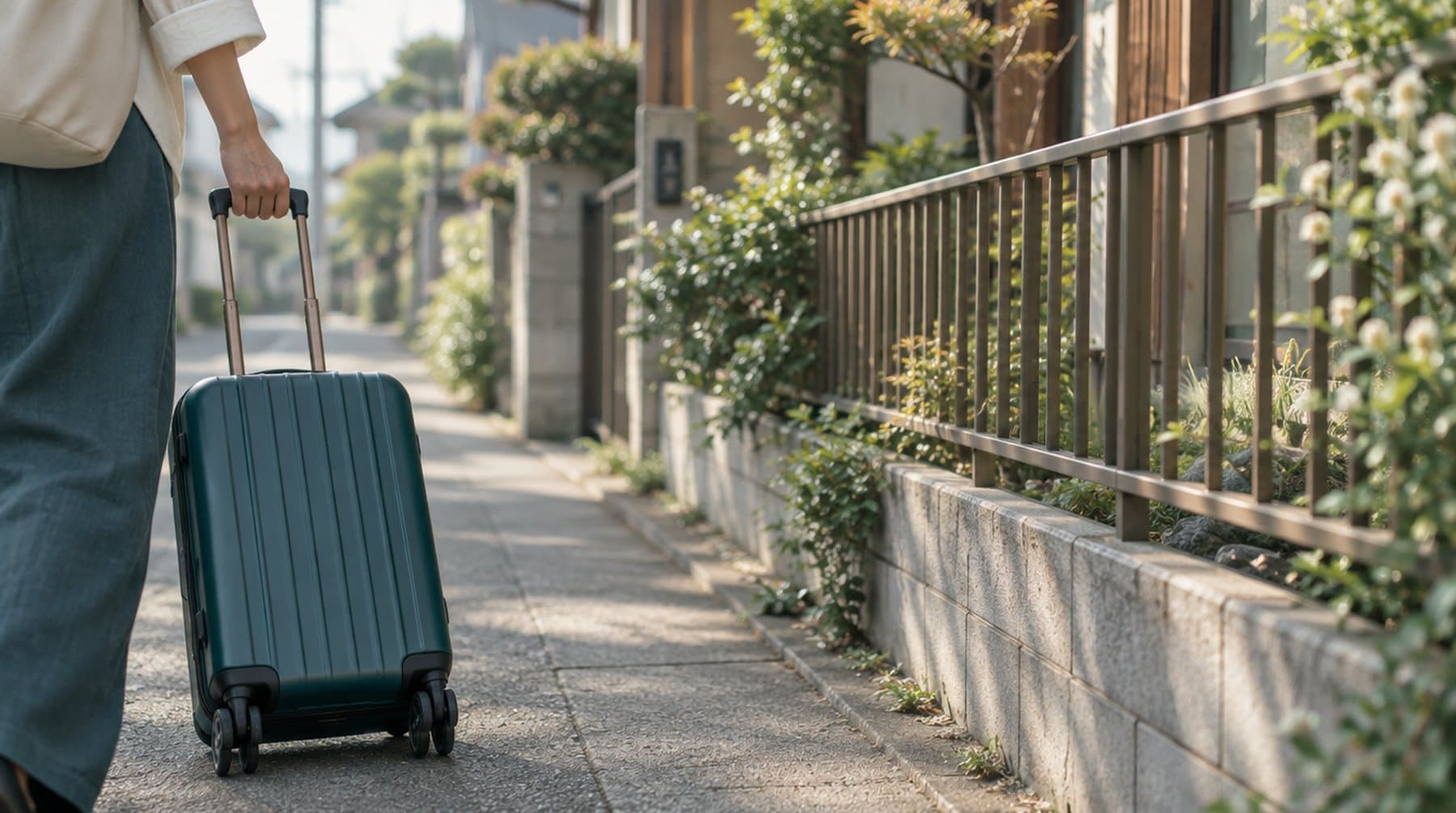
Our line is ten minutes on foot, and as a rule we do not take on addresses beyond it (the full list of reasons is in the properties we turn down). That is arithmetic rather than taste. Most inbound guests in Japan do not rent a car, so a room far from a station is one you fill by dropping the price, and the cleaning cost does not come down with it. Our three buildings sit at 30 seconds, 4 minutes and 4 minutes: at any of them a guest wheeling a suitcase is at the door inside five minutes of the ticket gate.
| Building | Nearest station | On foot |
|---|---|---|
| Heiwajima, Ota, Tokyo | Heiwajima (Keikyu line) | 30 sec |
| Kameari, Katsushika, Tokyo | Kameari (JR Joban line) | 4 min |
| Kita 15-jo Nishi, Kita-ku, Sapporo | Kita-18-jo (Namboku subway) | 4 min |
Does the walk hit your price or your costs?
Both, but the painful side is costs. More precisely, it hits you as a price you can cut and a cost you cannot.
In Japan the cleaning fee is an amount the guest pays once per booking, while the operator pays the real cost once per changeover (cleaning). At 83.6% occupancy and an average stay of 3.3 nights that is seven to eight changeovers a month per room (occupancy). Drop the nightly rate by ten per cent and neither the count nor the cost of each one moves.
Across our six rooms cleaning is 17.5% of revenue and the seven operating lines together are 27.9% (as of August 2026, broken out in operating costs). Shrink the denominator and those ratios rise by themselves. What goes wrong first at a distant property is not occupancy but the discount that buys it.
How does being near a station show up in reviews?
As praise, over and over. Of the 50 most recent reviews across our six rooms, taken newest-first for each room, 21 mention a station, the train or subway, or the walk to it (as of September 2026, all from Airbnb, written in English, Japanese, Chinese, Korean, German and French).
In that same set of 50, 48 are five stars and two are four, and what the two four-star reviews complain about is the size of the room and how much daylight it gets, not the distance to the station (across the six rooms we hold 364 reviews at an average of 4.9, as of August 2026, on our operating data page). How we think about stopping a rating from falling rather than raising it is in guest ratings.
Anything wrong inside the room can be fixed, while a sentence about the distance keeps being written for as long as the distance is there. Close to a station you are complimented for it every month; far from one you are explaining it every month.
Are distance to the station and time to the centre the same question?
They are two different questions, and confusing them means looking at the wrong thing at a viewing. The first is a load carried on foot by a tired person with luggage. The second is decided by the rail map and never changes.
All three of our buildings are inside four minutes of a station, and yet Tokyo Station is 19 minutes from one and 25 from another, while Sapporo Station is two subway stops, about four minutes, from the third.
Reviews separate the two cleanly. On the same Kameari building, one guest wrote that the JR line is three minutes away on foot; another wrote that the house is perfect but a little far from the city centre. The first is praise for something that cannot be changed; the second is a complaint that space and price can answer. The ward-by-ward picture is in Tokyo's 23 wards.
| Building | Walk to station | To the centre |
|---|---|---|
| Heiwajima | 30 sec | Shinagawa 6 min, Tokyo Station 19, Haneda Airport 10 |
| Kameari | 4 min | Ueno 15 min, Tokyo Station 25 |
| Kita 15-jo Nishi | 4 min | Sapporo Station 2 stops (~4 min), Odori Park 4 |
If the station is close, can the room be small?
The closer the station, the less a small room costs you. We have built to that difference on purpose.
Heiwajima is a studio sleeping two, 30 seconds from the station and ten minutes by train from Haneda Airport. Kameari is one building holding a unit for four and a unit for ten, four minutes from the station. The three Sapporo apartments sleep five, five and four, four minutes from the subway (each room is on our stays page). Read it the other way round: the further from a station, the more the room itself has to supply the reason for staying. How far a renovation gets you there is in turning an empty house into a licensed rental.
How should the walk be measured at a viewing?
Not from a map. Walk it yourself, from the ticket gate to the door of the unit, because that is the stretch the guest walks and a map measures to the centre line of the road. Six things to do at the viewing.
- Walk from the ticket gate to the door of the room. The stairs and corridors between the building entrance and the unit are not in the map's estimate
- Walk it pulling a suitcase. Steps, gravel, lanes without a pavement, a slope and a level crossing never appear in the minutes and all of them appear on the evening someone arrives
- Walk it once after dark. Which stretches have no street lighting and no one on them is invisible in daylight
- Check which exit is usable. At a station whose only open gate is on the far side, the real walk is minutes longer than the map's
- In a snow city, walk the same route thinking about February. In Sapporo the same four minutes weigh more in winter (winter in snow country)
Is a property far from a station hopeless?
Not hopeless, but it needs a different design. The materials that pay for distance are few: a layout that sleeps a group, guests arriving by car and parking on the plot for them, longer stays, and a reason to be there at all. Our three Sapporo rooms are within walking distance of Hokkaido University and its teaching hospital, so bookings that follow no tourist calendar turn up as a matter of course. Ten minutes means something different when the ten minutes end at a workplace or a hospital.
We still decline addresses beyond a ten-minute walk, because we cannot run them the way we run our own. What to do after a refusal is in the properties we turn down.
Would you manage a property eight minutes from the station?
If it is in the 23 wards of Tokyo or in Sapporo and can operate on a hotel-business permit, yes, we will come and see it at eight minutes. Past ten minutes the odds of a no go up sharply. Send the address, the nearest station and the walk as you measured it from the ticket gate, and we will give you a read before we travel.
What we take on is a property already operating under the hotel-business permit (旅館業許可, the Hotels and Inns Business Act route, with no annual cap on nights), or one whose owner wants to reach that permit. We cannot run a property that stays on the 180-night residential-lodging notification route (民泊新法) on the owner's behalf (the comparison is in permit or notification). We take at most five properties at a time, and we do decline some after the viewing and the enquiries to the authorities. The fee is performance-based, from 20% of revenue, with no fixed charge in a month without bookings, and the exact rate is quoted after we have seen the property. The occupancy and the rating in this article are our own record for our own six rooms, not a promise for anyone else's property.
Send the address and the walk, and ask