
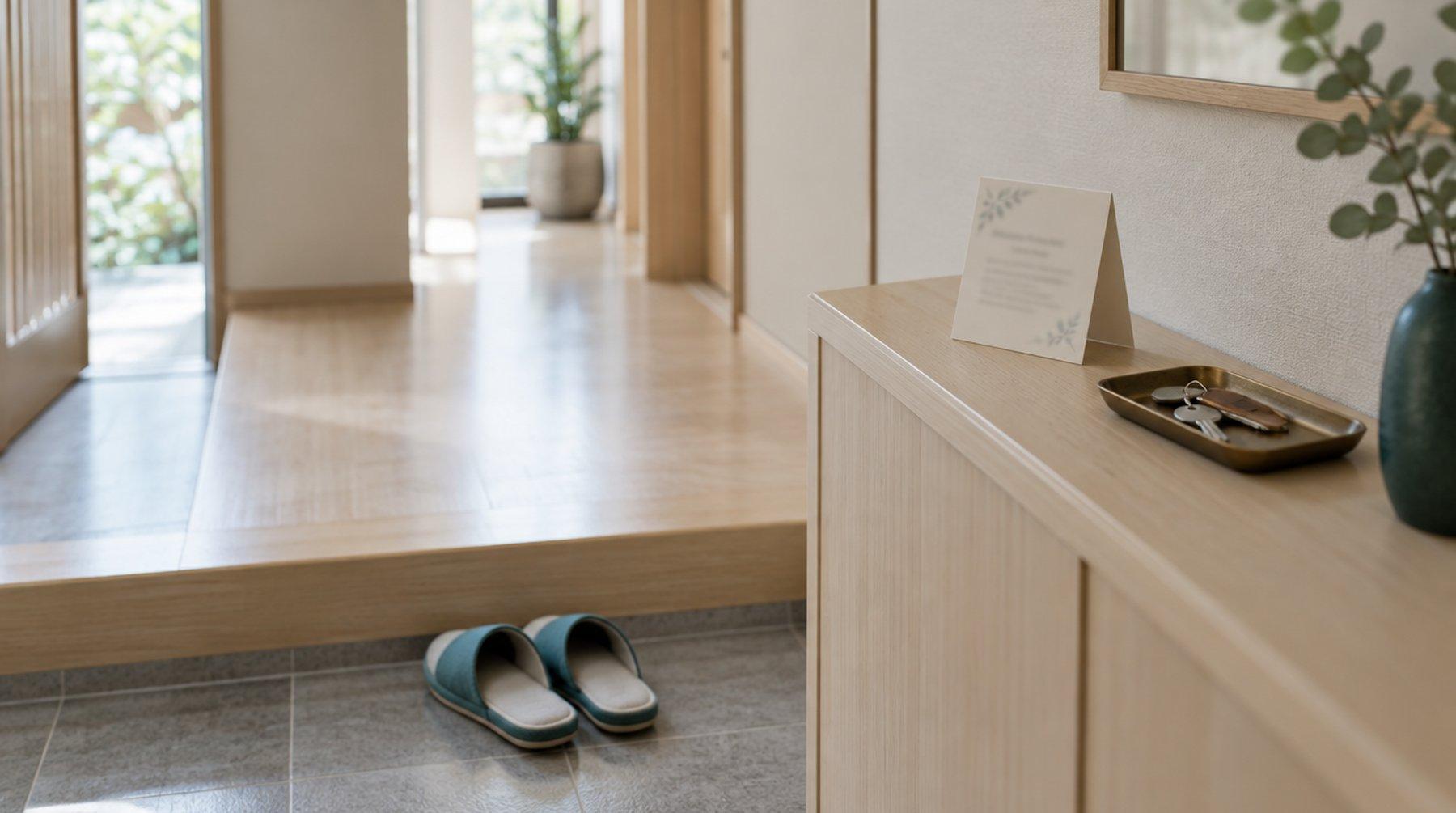
Our house rules are one set of 14, shared by all three buildings and six rooms we run in Tokyo and Sapporo. What changes by building is the night-time quiet hours and the checkout time, plus at most two rules of the building's own, such as keeping the slippers indoors or how the futons are handled (checked on 18 November 2026 against the settings of our eight listings and our in-room guides).
Each room takes a new arrival roughly seven times a month (515 bookings over six rooms from November 2025 to October 2026, operating data). Every one of those guests reads the rules for the first time, so we decide what goes where once, before opening, and change it only when something goes wrong.
What are house rules, and how are they different from the listing description?
House rules are the short list of promises a guest keeps during the stay. The listing description is there to make the right guest choose the room; the rules are there to stop the wrong booking from being made at all.
Both live on the same listing, but they do different jobs. How we build the photographs and the copy is covered in photographs and listing copy; this article is about the rules.
Where do rules need to be written to be read in time?
In four places, each read at a different moment. Rules that decide whether someone should book at all go where they are read before booking; how to behave in the room goes into the guide read after arrival.
Take smoking. Set it in the platform's house-rule fields and a smoker never books. Write it only in the in-room guide and it may be read after the first cigarette. Every one of our rooms is self check-in, so there is no front desk where someone repeats the rules on arrival: whatever the guest has not read by the time they open the door, nobody will tell them.
| Where it is written | When the guest reads it | What we put there |
|---|---|---|
| Platform house-rule settings | While searching, before booking | Pets, smoking, events, children, maximum guests |
| Listing description | Before booking | No smoking, no parties, quiet hours, names and passports |
| Message after booking | Before arrival | Collecting names and passports, then entry instructions |
| In-room and web guide | During the stay | All 14 rules, the checkout steps |
What do we set in the platform's house-rule fields?
On all eight listings, pets, smoking and events are set to not allowed. Children are not allowed on one listing only, a studio for two people, where infants are still welcome.
On Airbnb these are the switches under the listing's house rules; Booking.com and the other platforms have their own versions of the same fields. Maximum guests and checkout time follow the building, which is why a three-bedroom house and a studio carry different numbers. Platforms use these fields as search filters, so if they disagree with the description, the wrong booking comes straight through.
| Listing | Max guests | Checkout |
|---|---|---|
| HEIWAJIMA | 2 | 11:00 |
| KAMEARI 101 | 4 | 11:00 |
| KAMEARI 201 | 10 | 10:00 |
| SAPPORO NORTH 1A and 1B | 5 each | 11:00 |
| SAPPORO NORTH 1C | 4 | 11:00 |
How are the rules written into the listing description?
With the consequence, not just the ban. The description says that if a noise complaint comes in at night, the guest may be asked to leave, even at night, and that an emergency response fee is charged.
The second item is the names of everyone staying, plus a copy of the passport for guests who are not Japanese nationals. The description says before booking that entry instructions are not sent until these arrive, so nobody learns it for the first time after paying. It also says before booking that outside noise, such as construction nearby, cannot be compensated.
How do we write the rule about noise at night?
As a time window, not as "please be quiet at night". Our Japanese line reads, in translation, "No smoking, no parties. Please keep quiet from 21:00 to 07:00." Depending on the building, the window starts at 21:00 or 22:00 and ends at 07:00 or 08:00 the next morning.
All three of our buildings stand on residential streets within a five-minute walk of a station, and the people next door are ordinary households, not shops. A group coming home at 23:00 is heard through the walls of a Japanese house. We set the window per building, to match how the neighbours live. Where noise complaints actually come from, and how the first one is caught, is in neighbour complaints.
How much do we write about checkout and rubbish?
Checkout is cut to four steps: gather the used towels, gather the rubbish, lock up, return the key. The step titles are the same in every building; only what each step means differs.
In Japan, household rubbish is sorted by type and put out only on set mornings, so a guest cannot simply leave a full bag by the door; the guide tells them where it goes inside the room. The one rubbish line we write separately is that suitcases, large cardboard boxes and bulky packaging cannot be thrown away at the property. How sorting and collection days are handled is in rubbish at a rental. Later checkout is available as a paid extension, arranged by the day before.
In which languages, and in what kind of sentences?
The guide runs in ten languages, and each of the 14 rules says the same thing in every one of them. A rule is a title plus one sentence, with the fine print folded underneath.
Our last 50 reviews were written in seven languages (foreign guests). Long sentences get skipped, so each sentence carries one promise. As of 10 November 2026 we hold 431 reviews averaging 4.9.
How do you check what the law requires, such as the guest register?
We do not state it here. In Japan a licensed property keeps a guest register (宿泊者名簿), and what it must record and how it is kept depend on the permit conditions and on how the local authority applies them. Ask the public health centre (保健所) that covers the property, then write the answer into the rules and the post-booking message. The questions to take with you are listed in foreign guests.
Collecting every name and passport after booking, and sending entry instructions only once they are in, is our own practice. How the permit process runs is in getting a hotel-business permit.
What should you ask a management company, and what we will not promise
Before the list of rules, ask to see the actual wording in each of the four places. What to look for is whether the times and guest numbers agree between the platform settings, the description and the in-room guide.
We use the 14 rules as a shared base, set the quiet hours, maximum guests and checkout time per building at the inspection, and add a rule only where one building needs it. We do not tell an owner that complaints will drop. What we commit to is that when something goes wrong, the wording in all four places is brought back into line the same day.