
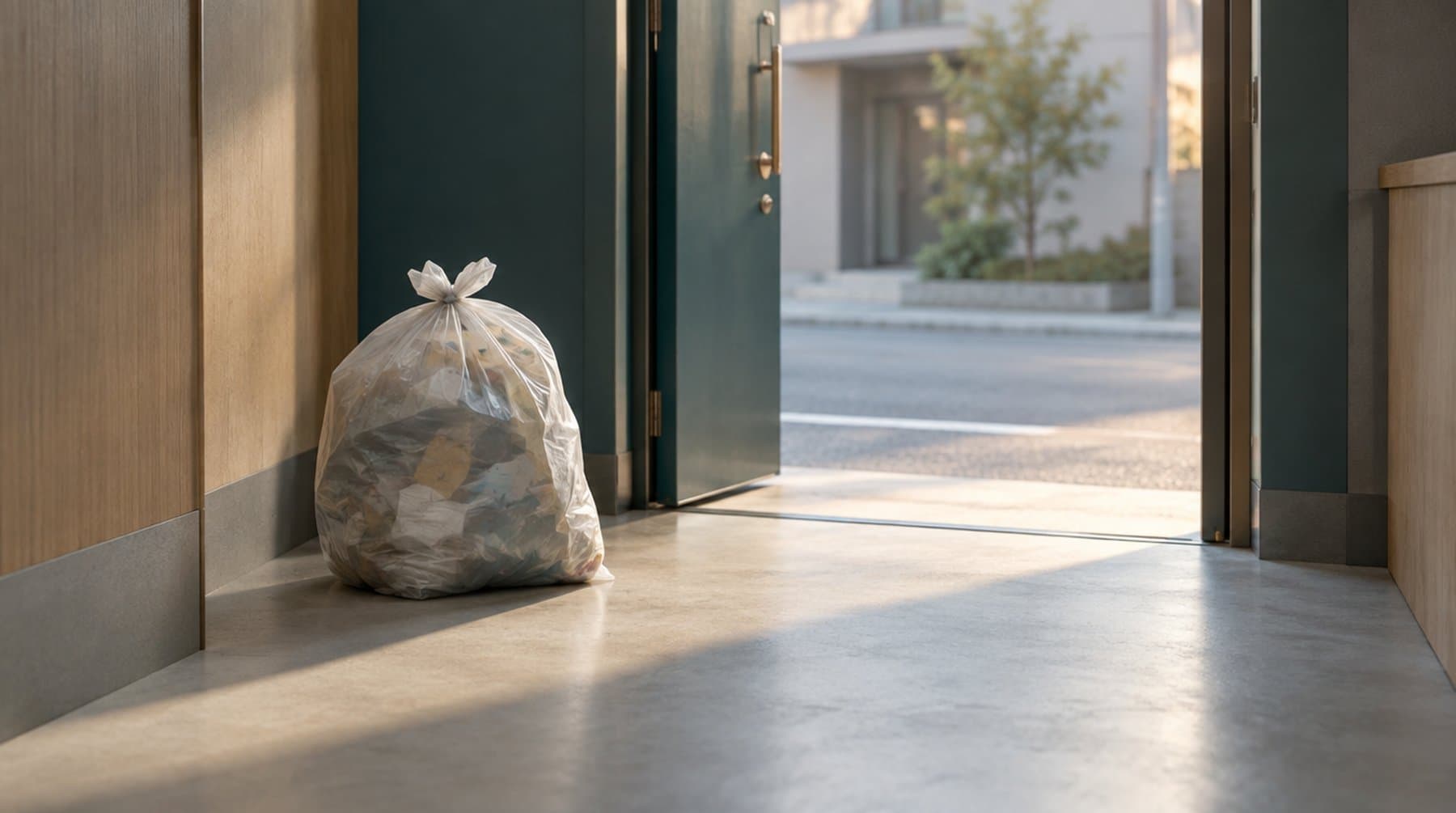
Rubbish is not a choice between leaving it to the guest and taking it away yourself. In our three buildings the answer is different in each one, and what decides it is not the local ordinance. It is the distance from the door to the street collection point, and whether there is anywhere on the site to let a bag stand for a day.
Some vocabulary first, because none of it translates cleanly. A shuuseki-jo is a shared collection point out on the street, used by the whole block, with no bin: bags are set down on the morning of their day and the truck takes them. Several cities sell a compulsory paid bag, and some wards sell a paid sticker that goes on each bag instead. A chounaikai is the neighbourhood association, which often owns the collection point even though the city runs the truck.
No table of collection days by ward here: it would be out of date the day it was written. What follows is how our own three buildings and six rooms run as of October 2026, and what our guest manuals actually say. The occupancy and cost figures are as of August 2026, over twelve months, with the method published on our operating data page.
Who actually carries the rubbish to the collection point?
The rubbish left on the day of departure is carried out by us, at the changeover, in all three buildings. What we ask of the guest is the sorting, and getting the bag as far as a place we have chosen.
Rubbish during a stay is where the buildings differ. The Heiwajima and Sapporo manuals print the collection days, so a guest staying a while can put a bag out themselves. The Kameari manual prints no days at all: sort indoors, and on the way out put the rubbish in the box outside the door.
| Building | What we ask the guest to do | Who puts it on the street |
|---|---|---|
| Heiwajima (Ota, Tokyo) | Sort, and set it at the spot in the photo by 8am on its day | Guest during the stay, us on departure day |
| Kameari (Katsushika, Tokyo) | Sort indoors, put it in the box outside | Us, always |
| Kita-15-jo-nishi (Kita, Sapporo) | Sort into the city's paid bags, one collection day per type | Guest during the stay, us on departure day |
Why can departure-day rubbish never catch the truck?
Because the deadline and the checkout time are three hours apart. At the Heiwajima building bags go out by 8am on the collection morning, and our checkout is 11am (10am for one Kameari unit).
Counting the changeovers makes it sharper. Burnable rubbish is collected twice a week there. At 83.6% occupancy and an average stay of 3.3 nights, a room turns over seven to eight times a month (the cleaning turnover), so on average about two of those departures land on a collection day, and both of them are three hours late for it.
The bag therefore waits somewhere. Deciding where it waits is the whole of rubbish management, and the day it waits on the pavement is the day the first complaint arrives (neighbour complaints).
Why did the three buildings end up with three arrangements?
Not the ordinance. Three conditions belonging to the building itself.
- The distance from the door to the collection point, and whether a guest with a suitcase walks that stretch anyway
- Whether there is anywhere on the site a bag can stand for a day or two. Kameari has a box outside, which is why sorting indoors and dropping it in is the entire instruction there
- How the bags and stickers get bought. Sapporo requires the city's paid designated bag; the Heiwajima building needs a paid disposal sticker on each bag. Neither can be left to a guest to go and buy, so both are stocked in the room
How much of the sorting rule actually reaches the guest?
Prose does not reach them. Photographs and a place to put things in the room do.
Our guest manuals run in four languages, English, Japanese, Chinese and Korean. The collection point is a photograph with a red frame drawn round the exact spot, and the paid bag and the sticker are photographed as objects. Inside the flat there is a labelled place for each stream: four at Kameari (burnable, PET bottles, glass and cans, non-burnable) and three in Sapporo (burnable, plastics, bottles with cans and PET).
Mistakes still happen. The design assumption is that they will, so a bag gets opened and corrected at every changeover. Budget that correction and nothing goes wrong; leave it out, and the complaint arrives on the day a wrongly sorted bag is left behind at the collection point. A property where those three conditions do not line up costs more effort every month on rubbish alone, which is why we walk the route at the viewing (the properties we turn down).
Which cost line does rubbish sit in?
It is not a line of its own. It sits inside cleaning.
There is no rubbish row in the seven operating lines we publish, which come to 27.9% of revenue. The person who carries the bag is the person who cleans, so it is part of cleaning's 17.5%; the bags and the stickers are consumables, which are 4.2% (as of August 2026, broken out in what operating a rental costs).
So there is no real way to make rubbish cheaper. The number of trips is set by the number of changeovers, and no amount of negotiating moves it. The only count that can be reduced is the number of arguments.
How do I find out the rules for my own property?
Do not assemble the answer from searches. Call the waste collection desk at the ward or city office, tell them the address and that the property will be used for paid accommodation, and get these five answers in one call.
- Whether waste from that property counts as household or commercial. The sorting, the bags and the way it is paid for all change on that answer
- Whether the nearby collection point may be used, and whose permission that takes. The point is often managed by the neighbourhood association, so the office's answer and the street's answer can differ
- The collection day for each stream, and the deadline on the morning
- Whether a paid designated bag or a paid sticker is required, and where it is sold
- If collection has to go through a contractor, which contractors serve that area
Can you run the rubbish side as well?
Yes. For a property in Tokyo's 23 wards or the city of Sapporo that can run on a hotel-business permit, we walk the route to the collection point and look for the holding spot at the viewing, then set it up the way our own three buildings run. The five answers above differ by municipality and they change, which is why this article carries the order of the questions and not a table of the answers (the same reason there is no table of ward rules in Tokyo's 23 wards).
We take on properties that already hold a hotel-business permit (ryokangyo kyoka) or are going to get one. We cannot run a property that stays under the 180-night notification framework (permit or notification). We hold at most five properties at a time, and we do decline after a viewing or after checking with the authorities. The fee is performance-based from 20% of revenue, with nothing fixed to pay in an empty month. The occupancy and cost shares in this article are our own record, not a promise about another property.
Send the address and the walk to the collection point