
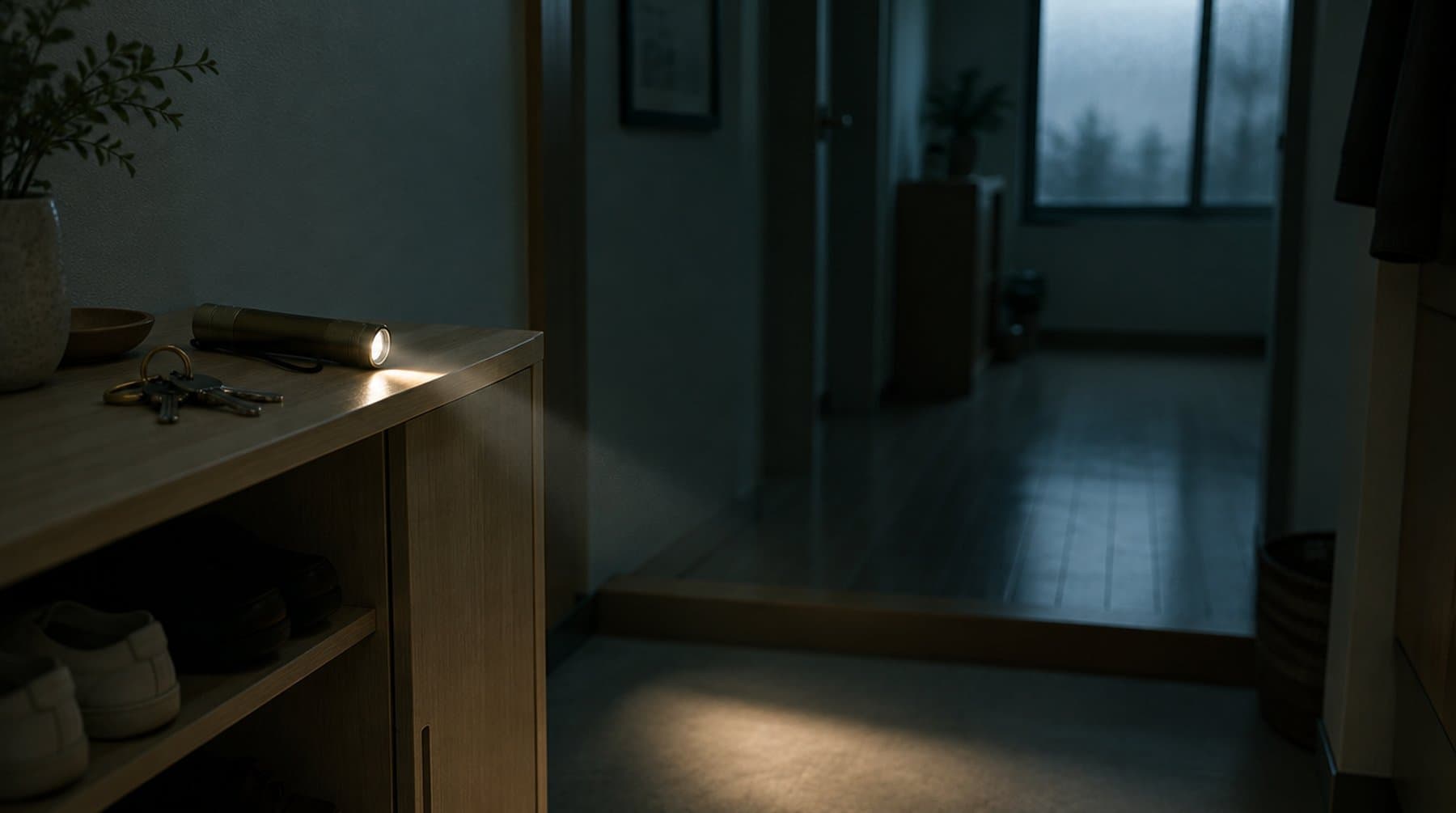
When something goes wrong at night, the first job is not the repair. It is two things: stopping the damage from spreading, and deciding whether the guest can safely sleep in that room tonight. The repair is the next morning's work.
By emergency we mean a physical event that puts the guest's safety or the building at risk. Replying to routine questions at night is covered in does a rental need 24-hour guest response, and daytime breakdowns and the repair budget in the day something stops working. This piece is the night procedure we use across three buildings and six rooms in Ota and Katsushika wards in Tokyo and Kita ward in Sapporo, all run under a hotel-business permit (旅館業許可).
What counts as a night emergency?
We keep a written procedure for six events. In every one, the first report is received around the clock, everything that can be done remotely is done first, and a person goes out only for what is left.
| Event | First remote step | Does someone go out? |
|---|---|---|
| Water leak | Show the guest, by photo, where the shut-off valve is | If the water will not stop |
| Power cut | Work out whether it is the room or the whole area | If it is the room and will not come back |
| Locked out, key lost | Issue a new door code | For a flat battery or a physical key |
| Air conditioning dead in summer | Check settings, remote and breaker | If it stays dead, we consider moving the guest |
| Earthquake | Check every guest is safe; ask about gas and water | The building is inspected next morning |
| Heating dead in a Sapporo winter | Reset the breaker and the heater | If it stays dead, someone goes that night |
Water is coming through at night. Where do you start?
By stopping the water. Finding the cause comes after.
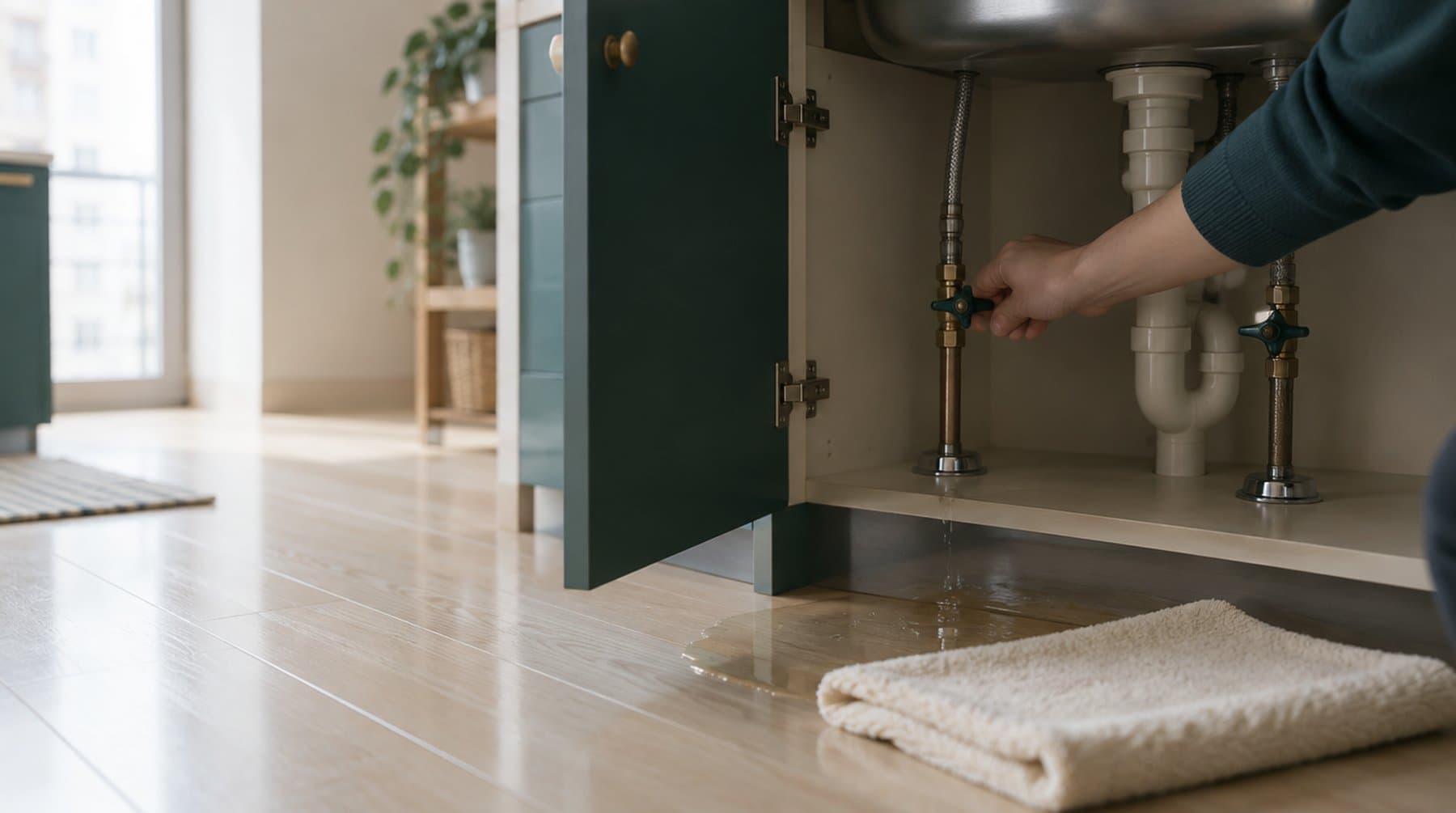
Every room has a guide with a photograph showing where the shut-off valve is, and the guest turns it. Once it stops, we ask them to photograph the wet areas before anything is wiped up. Whether to claim on the insurance is decided the next day, but the record can only be made that night (insurance at a Japanese rental).
In an apartment building the next thought is the flat below. Water travels under the floor, so a dry room is not the end of it. The order in which the downstairs neighbour and the building's management company are told is settled per property in advance, not improvised at 2am.
The power goes out. How do you tell what kind of outage it is?
The first question is whether only the room is dark or the whole area is. The answer changes everything that follows.
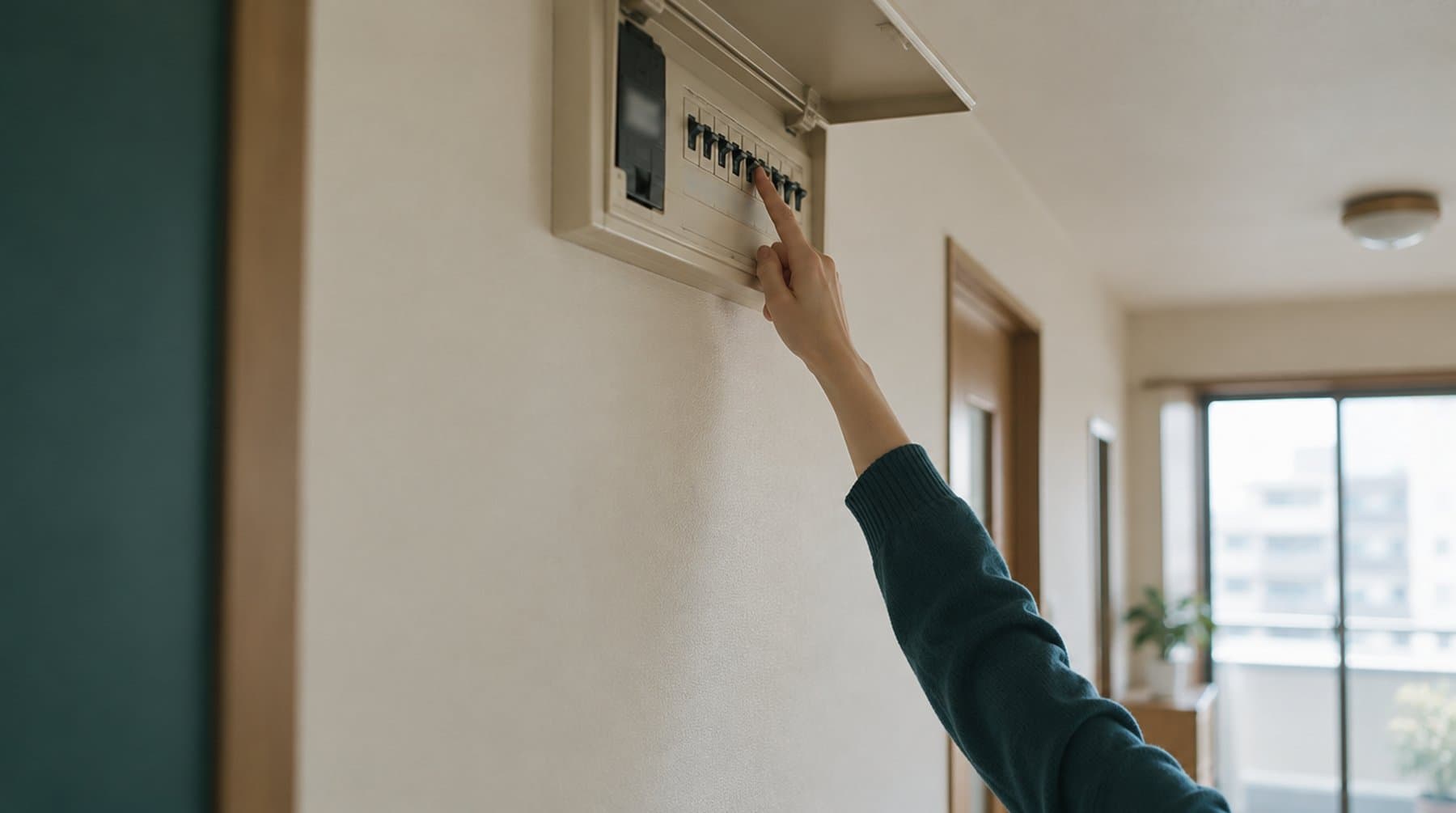
If the area is down, we check the power company's outage information for the extent and the expected restore time, tell the guest, and wait; nobody we send can fix the grid. If only the room is down, it is usually the breaker. Japanese flats have a small panel of switches, often high on a wall near the entrance, and a photo showing where it is and which switch to lift resolves most cases in minutes. If it trips again, we ask what was switched on just before, have that unplugged, and try once more.
When does a person actually go out?
For water that will not stop, a room nobody can get into, and a winter night without heating. Each of these gets worse, or more dangerous, if left until morning.
We have our own cleaning teams in both Tokyo and Sapporo, and they double as the people who go out at night. Arrival time depends on the hour, the weather and the roads, so we do not promise a number of minutes. Whoever goes carries the building's own sheet: where the shut-off valves and the breaker panel are, and where the spares are kept. This is also the one reason we do not take properties anywhere we cannot send a person.
When is a guest moved to another room?
When we decide they cannot safely sleep in the room tonight: water that will not stop, no heating on a winter night, or air conditioning that will not come back on a summer night.
The new room is almost never one of ours. Our rooms averaged 83.7% occupancy over twelve months, which leaves about five unbooked nights per room per month. In August 2026 occupancy was 89.2%, about three free nights per room, and in Sapporo in February 2026 it was 94.0%, fewer than two (our three buildings and six rooms, measured 1 October 2026, published at operating data). The months when air conditioning fails and the months when heating matters most are exactly the months with the fewest empty rooms. In practice, a moved guest goes to a nearby hotel.
We do not promise here who pays for that. It depends on three things: the booking platform's own rules, the management contract and the insurance policy. The places to read are the contract and the policy's coverage (reading a management contract). If it is not decided beforehand, it gets decided in the middle of the night.
What changes in an earthquake, or in a Sapporo winter?
After an earthquake, people come before repairs. We contact every guest staying that night to confirm they are safe and ask whether gas and water are working. The steps for restoring the gas supply are photographed and left in the room. The building itself is inspected the next morning, in daylight.
In a Sapporo winter, a heater that stops is a safety question rather than a comfort one. Keeping pipes in empty rooms from freezing, by draining them or holding a minimum heat, is covered in winter in snow country. On a winter night, if the heating cannot be restored remotely, someone goes out without waiting for morning.
What should I ask a management company about emergencies before signing?
Four questions, each with a single answer.
- If water will not stop at 11pm, who takes the call and who goes out? Ask for an answer with a name in it.
- Up to what amount can they order a repair without asking you first?
- How do the contract and the insurance split the cost of moving a guest, and of damage to the flat below?
- In which cases, and only which, will you be woken at night?
Under our fees, repairs and replacements are charged at actual cost when they arise, as are cleaning, linen and supplies (how our fees work). Over the same twelve months, equipment and furnishing repairs came to 1.0% of revenue and insurance to 0.4%. Neither is a forecast for another property.
Before you hire us
With one property close to home, you may be able to cover the nights yourself (self-managing or hiring an operator). Our service area is the Greater Tokyo area and Sapporo, Hokkaido. Farther areas depend on whether we can send someone at night, so please contact us and we will consider them case by case.
We also consult on minpaku-law properties: the two frameworks differ in conditions such as how many nights a property can operate, so we suggest the approach that suits the property, including a switch to a hotel-business permit. The shares quoted here are from our own six rooms and are not a promise of occupancy or costs for any other property. The management fee is 20% of revenue.
Talk to us about your property