
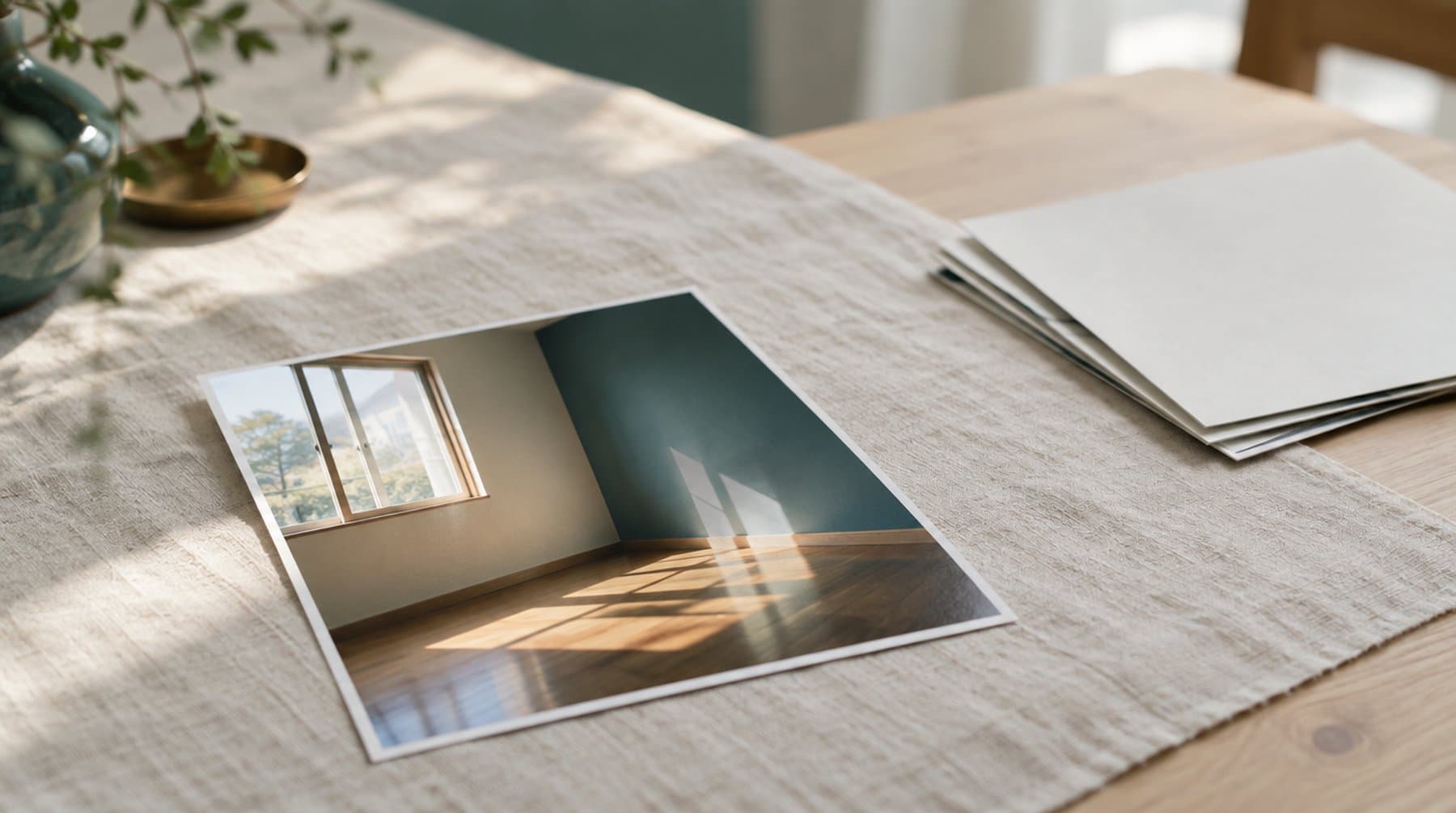
Listing photographs and copy are the thing to look at before the price when a calendar is not filling. What we cannot tell you, even from our own record, is how many more bookings a better photo set produces.
What follows is the photo count of our eight listings as of 6 October 2026, and the 489 reservations that arrived in the twelve months from October 2025 to September 2026, counted on 1 October 2026, with the method published on our operating data page. No amounts: everything here is a count of pictures, reservations or days.
How much do better photographs and copy lift bookings?
We cannot give you a percentage. Even at three buildings and six rooms, our own portfolio does not produce enough reservations to separate the effect of a photo set from everything else moving at the same time.
489 reservations over twelve months, divided by six rooms and twelve months, is about 6.8 reservations per room-month. The median gap between booking and arrival is 42 days, so a photo set changed today is not fully reflected in bookings until well past six weeks. That leaves roughly two months to judge on, about 14 reservations in one room. Fourteen moves with the season, with where the public holidays fall, and with one comparable room opening near the same station.
So if a company quotes you an uplift percentage for a property it has not run, ask where the number came from. We do not quote one. What we can say is which part of the decision these things own. Price moves how fast a date sells; photographs and copy move whether you are chosen once you have been seen. Reaching for the price first leaves the reason you were not chosen exactly where it was (how the nightly rate is set).
Why does the first photograph outweigh the other 59?
Because in a list of search results the first picture and the title are the only things a searcher is guaranteed to see. Everything else is seen only after the click.
Our eight listings carry 518 photographs between them (as of 6 October 2026). Eight of those, the first of each listing, stand in the search results: 1.5% of the pictures. The other 510 start working only once the first one has done its job.
What we ask of that first picture is not that the room looks impressive, but that one frame says what kind of place this is. We shoot it from where a guest spends the most time, not from the corner that makes the room look widest.
| Listing | Photographs |
|---|---|
| Tokyo, the Heiwajima room | 35 |
| Tokyo, Kameari ground floor | 56 |
| Tokyo, Kameari first floor | 77 |
| Tokyo, Kameari whole house (both floors) | 80 |
| Sapporo, Kita-18jo, first room | 52 |
| Sapporo, Kita-18jo, second room | 67 |
| Sapporo, Kita-18jo, third room | 75 |
| Sapporo, Kita-18jo, two rooms together | 76 |
How many photographs does a listing need?
The count follows how many places there are to stand in the property, not how much effort went in. Our six rooms run from 35 to 77 pictures, averaging 60.
Thirty-five is not an under-shot listing: it is a studio, and there are fewer places to stand. Seventy-seven is a house with several bedrooms photographed at the same density. The test worth using is not a number but whether every place a guest stops is in the set: the entrance and where shoes come off, the bath, the toilet, the working surface in the kitchen, the washing machine, each sleeping place, where rubbish is kept, and where the key is.
A whole-house listing is not the sum of its rooms. Kameari has 133 photographs across its two floors, 56 and 77, but the whole-house listing carries 80. Someone booking the whole house wants the number of rooms and how they connect; showing the same kitchen twice decides nothing. Each listing gets its own selection.
What always goes into the copy, and what never does?
Anything that would be a problem to discover on arrival goes in first.
Leave it out and you still get the booking, but it comes back in the review. Seven things are always written into ours.
- The route from the station, the walking minutes, and whether there are slopes or stairs. All six of our rooms are within a four-minute walk, so it goes in the opening lines (distance from the station)
- The bed breakdown. Not "sleeps five" but what is in which room
- Which floor, whether there is a lift, and whether large luggage can get up
- Whether there is a washing machine and whether cooking is possible. If not, that is written too
- Arrival and departure times and how the key is collected (key handover)
- How rubbish is handled and where it may be left (rubbish on a Japanese rental)
- What is not there: parking, a bathtub, a lift, quiet. If the building is beside a railway line, the copy says so
When can a photo change be read?
Two months at the earliest. At a 42-day median lead time, that is how long it takes for the bookings made after the change to have landed.
Which is why only one thing changes at a time. Move the pictures and the price in the same week and you will never know which worked. The rate is reviewed daily in normal operation (how the nightly rate is set), so while a photo set is being tested we hold the floor rate still.
The weeks right after a handover are the exception, and they have to be read differently: a rebuilt listing's numbers carry whatever the platform does with a new listing mixed into them. Reading that period as the result of the photographs is usually reading it wrong (switching management companies).
| What changed | Readable after | Hold still meanwhile |
|---|---|---|
| The first photograph | About two months | Price, minimum stay |
| The order of the photographs | About two months | The first photograph |
| The title | About two months | The first photograph |
| The body of the listing copy | Two months and more; it also shows up late in reviews | The property itself |
Where does an over-flattering photo set send the bill?
To the reviews. Whatever a guest felt was oversold on arrival does not come off that month's bookings, it goes onto the next six months of ratings.
Our six rooms carry 398 reviews averaging 4.9 (as of 1 October 2026). A rating sits on top of that count, so once it drops it takes a long time to come back (guest ratings). The extra bookings a flattering photo buys do not balance against the mark it leaves.
We hold two lines. Everything visible in a photograph is in the room on the night someone stays. Anything unflattering that is not visible goes into the copy instead. Wide lenses are normal and we use them, but not at an angle that changes the shape of the room, and the brightness stops at what the room looks like with the curtains open in the afternoon.
Who owns the photographs and the copy when the contract ends?
Whatever the contract says. If it says nothing, assume the day you leave is the day you pay to shoot and write it all again.
Three things to check: who pays for the shoot, whether the pictures may still be used after termination, and whether you receive the originals, meaning the unedited photographs and the listing copy as text. They sit in the same group of clauses as whose name the listing account is in, and they set the price of leaving rather than the price of staying. Where to read them is set out in reading a management contract, eight clauses in order.
On our side the listing account stays in the owner's name, and the photographs and the copy are handed over with their originals. The principle is not to build anything that becomes a hostage on the way out.
Can you just do the photography and the copy?
No. The pictures are part of the listing, and the listing sits on the same circuit as the rate, the cleaning, how guests are answered and what they write afterwards. Change the first photograph on a room that disappoints on arrival and the extra bookings come straight back as stars.
We work in Tokyo's 23 wards and the city of Sapporo, with properties that hold a hotel-business permit (旅館業許可, the framework a hotel runs on, with no 180-night cap) or are going to get one. We cannot run a property that stays under the 180-night notification framework (permit or notification). We hold at most five properties at a time and we do decline after a viewing (the properties we turn down).
The fee is performance-based from 20% of revenue, with nothing fixed to pay in a month without bookings. Every figure here is our own record, not a promise of bookings or ratings for another property. How to compare fee models is in what management costs.
Send the address and the listing URL for a read on what is visible from outside