
For eight people or more in Tokyo, book one whole house rather than a block of hotel rooms. We run one: a two-storey house in Kameari, in the north-east of the city, four bedrooms across two self-contained apartments, four minutes on foot from the station, taken as a single booking for up to 14 guests. The rest of this article is the reasoning, including the part where a house is the wrong answer for your group and a hotel is the right one.
Why do Tokyo hotels struggle with groups?
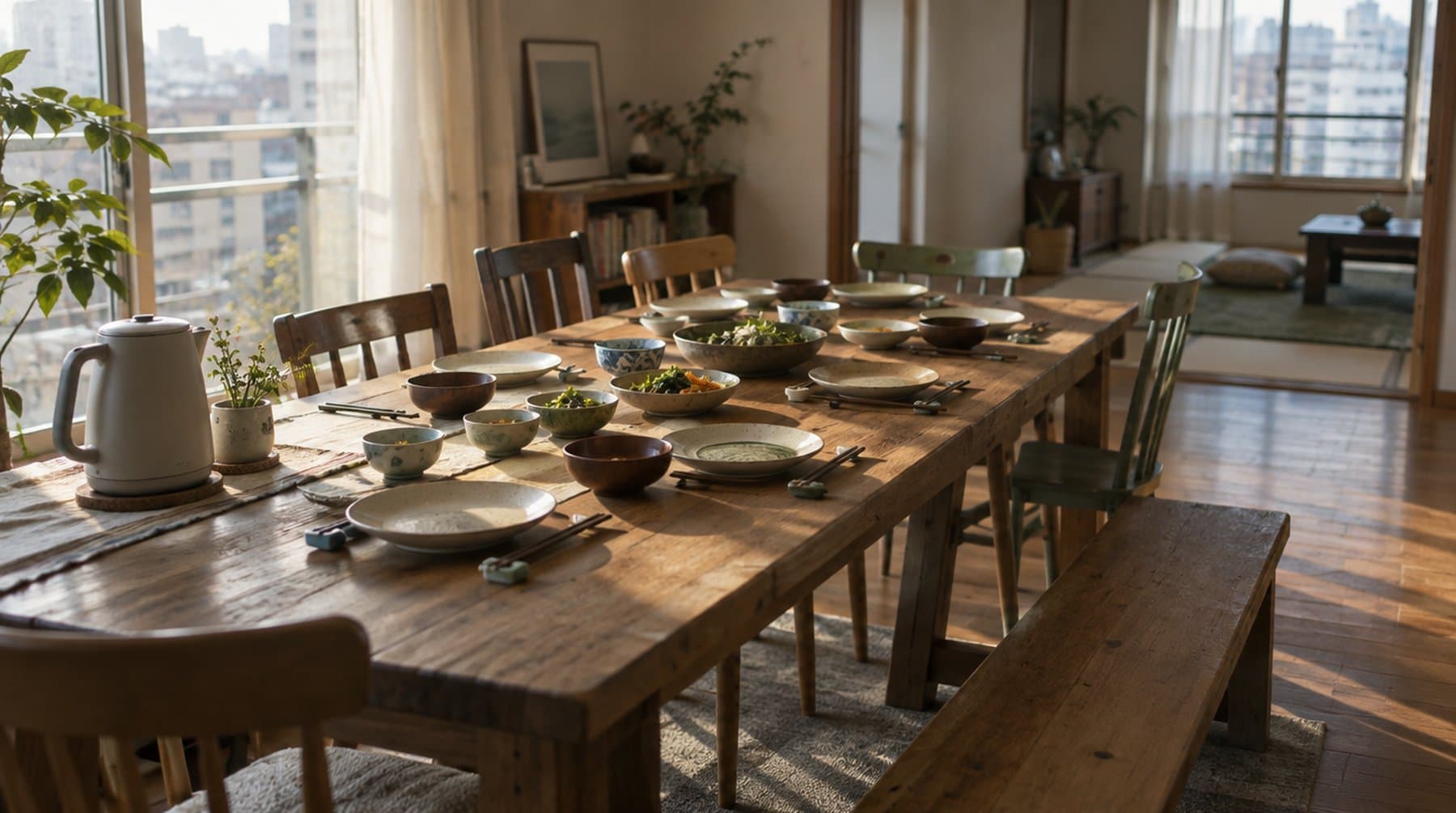
Because the unit a Tokyo hotel sells is a room built for two, and a group is not a multiple of two. Ten people become five rooms, five key cards, five bathrooms you pay for and one that is free when you need it, and a third person in a room usually means an extra-bed fee on a floor area that was tight for two. Rooms are assigned at check-in rather than reserved as a block, so the group that booked together lands on three different floors, and the only place fourteen people can sit down together is a restaurant, at restaurant prices, three times a day.
None of that is a complaint about Japanese hotels, which are efficient at what they do. It is a mismatch: their product is a bed and a bathroom per couple, and a group needs one kitchen, one table and one front door.
| Option | Works for | The catch |
|---|---|---|
| A block of hotel rooms | Any group size, anywhere in the city | Rooms assigned at check-in, so the group can be split across floors; nowhere to sit together, no kitchen, laundry by the load |
| Two apartments in one building | Two families or two couples who do not need one shared table | Two front doors and two sets of instructions; the group naturally splits in the evening |
| One whole house | 8 to 14 people who want one table, one kitchen and one door | One bathroom per floor, house rules a hotel would absorb on your behalf, and very few of them exist near a station |
What does a whole house in Tokyo actually look like?
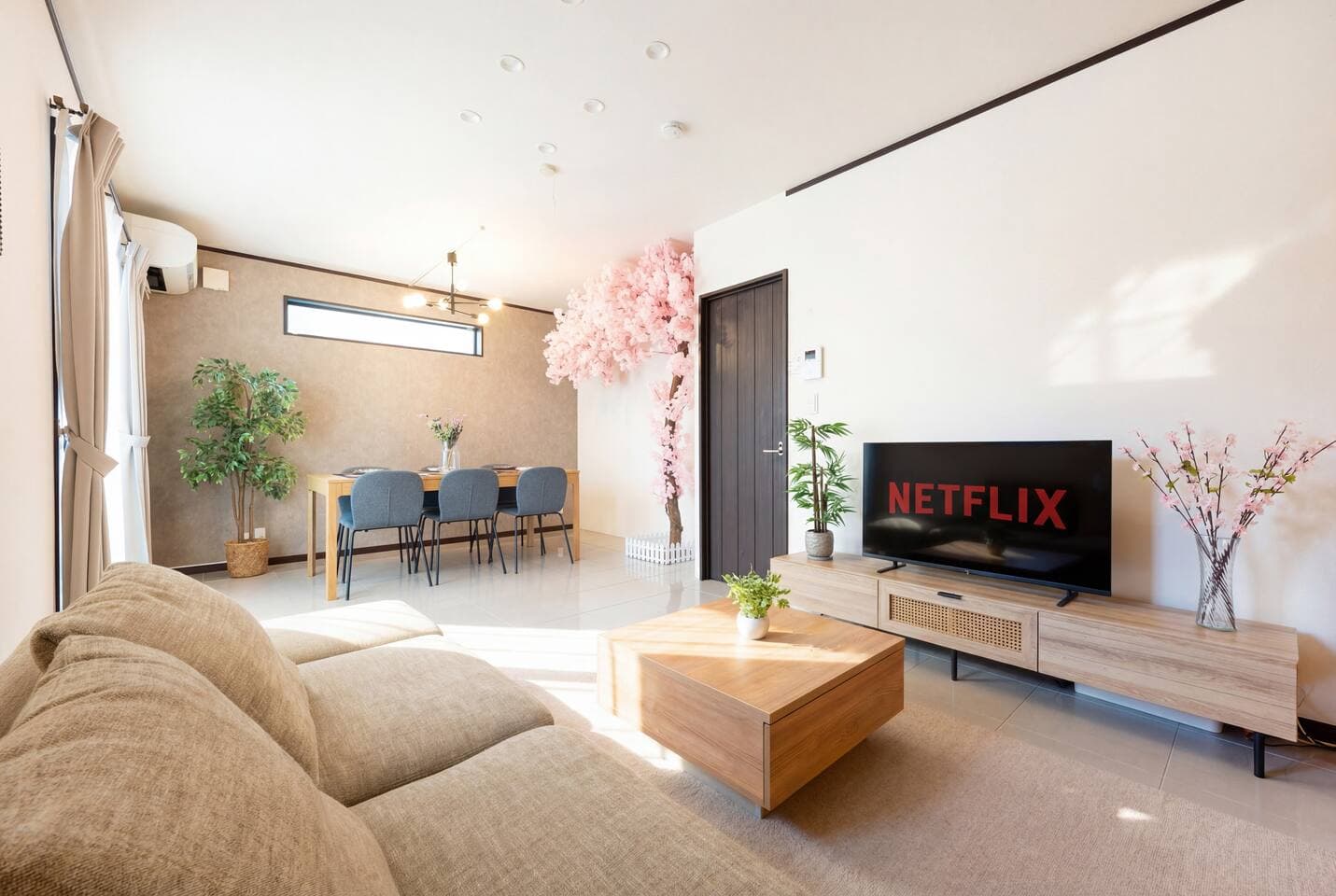
Ours is a two-storey house divided into two apartments, 101 on the ground floor and 201 above it, booked together as one stay for up to 14 people. Four bedrooms: one with a double, one with two small doubles, one with a double, a single, a floor mattress and a crib, and one more with a double. The living room adds a sofa bed and a floor mattress. Each floor is a complete home of its own, with its own kitchen, its own bathroom and its own washer-dryer, which is what makes the arithmetic work: two kitchens means breakfast for fourteen does not queue behind one kettle.
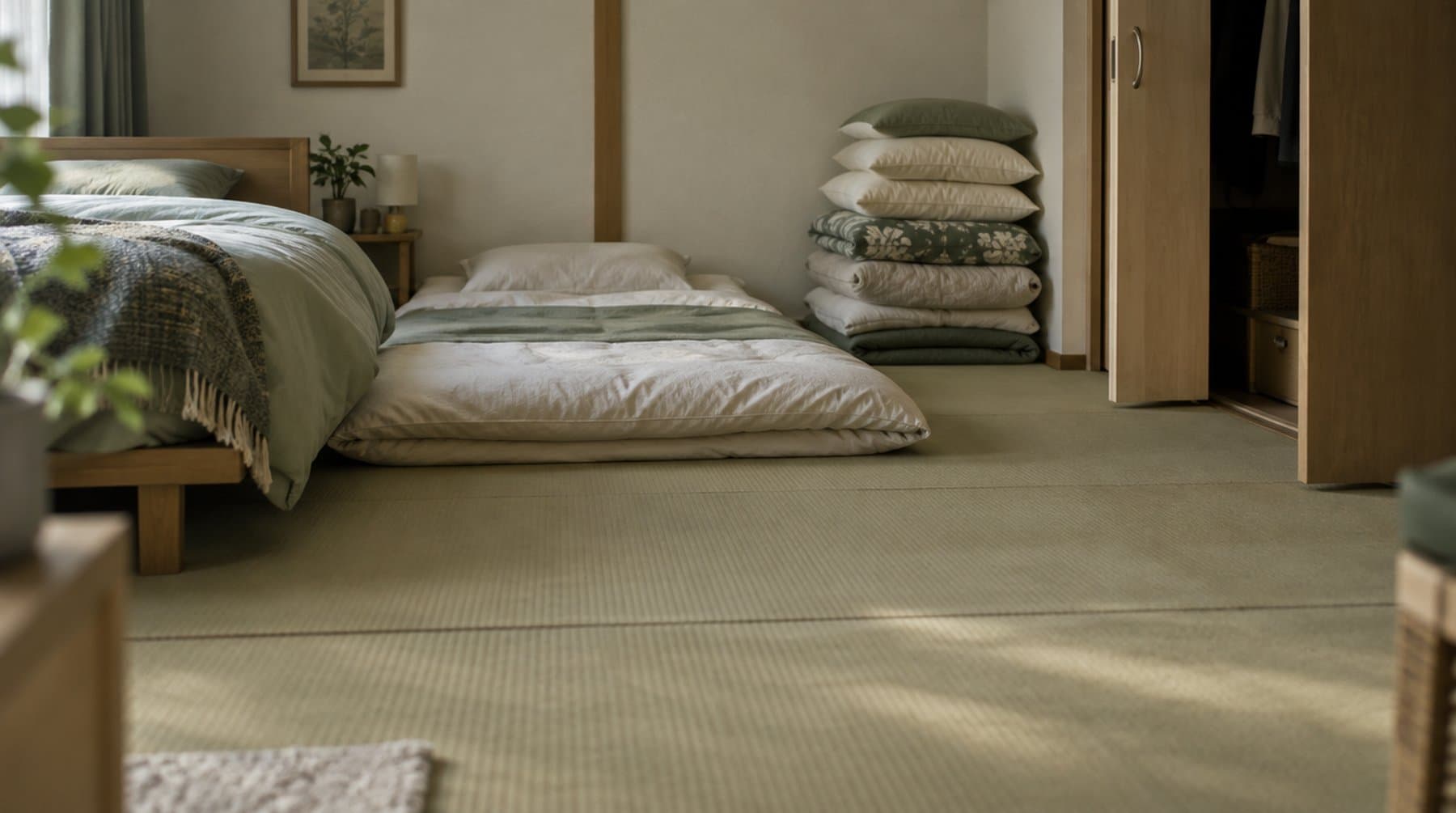
The part worth saying out loud before you divide up the group: at fourteen, some people sleep on a futon or a floor mattress rather than a bed. That is ordinary in a Japanese house and extra pillows and blankets are provided, but it decides who sleeps where: settle it before arrival rather than at 23:00 in the genkan. The room-by-room breakdown is on the stay page.
Eight to ten people: is one floor enough?
Yes, if the group is ten or under and can live with one bathroom: the upper apartment on its own has three bedrooms and sleeps up to 10. That is the cheaper booking, and for a single family or one group of friends it is usually the right one. Note one detail that catches people out: taken alone, the upper apartment checks out at 10:00, while the whole house checks out at 11:00. On a departure day with ten people and a pile of luggage, that hour is not nothing.
Take the whole house instead when the group is really two groups: two bathrooms and two kitchens matter most when children go to bed at 20:00 while the adults are still at the table. The ground-floor apartment on its own sleeps four, so the building can also be booked as four plus ten.
How do you work out whether the bathrooms are enough?
Count showers, not beds: this is the number that decides whether a large booking feels generous or cramped, and almost nobody checks it. A Japanese house of this size has one bathroom per floor, so fourteen people share two. What makes that workable is a detail visitors do not expect: in a Japanese home the toilet, the washbasin and the bath are usually three separate rooms, so the queue is for the shower alone rather than for everything at once.
The practical habit is the Japanese one: baths in the evening, one after another, and quick showers in the morning in an agreed order. If your group cannot live with that, say so early. For nine people who want two full bathrooms, our Sapporo pair of apartments is the better booking, and in Tokyo the right answer may be two separate apartments or a hotel after all. We would rather say so than have a group of twelve discover it at 07:30 on day one.
How far is Kameari from the places a group wants to go?
One train, no transfers, for most of a Tokyo itinerary: Ueno in 15 minutes, Asakusa and Akihabara in 20, Tokyo Station in 25, all from a station four minutes' walk from the door. For a group this matters more than being central: twelve people do not clear a ticket gate or a staircase together, so every transfer costs ten minutes, and two of them each way is most of an hour spent counting heads.
| From Kameari | Time |
|---|---|
| Kameari Station (JR Joban Line) | 4 min walk |
| Ueno | 15 min by train |
| Asakusa / Akihabara | 20 min |
| Tokyo Station | 25 min |
| Tokyo Disney Resort | 45 min, direct bus |
| Haneda Airport | 60 min, direct limousine bus |
- The Disney bus and the Haneda limousine both leave from the station, which is the difference between a group trip and a group logistics exercise.
- There is free parking on the property, so a rented van for a ski or countryside leg has somewhere to sit.
- Luggage can be dropped off before check-in, which matters when a group lands in the morning and check-in is at 16:00.
- The neighbourhood itself is an old Tokyo shopping-street district rather than a tourist quarter, which is a large part of why we like it; there is a guide to Kameari if you want to know what is around the house.
What changes in the house rules when there are twelve of you?
The rules do not change, but the consequences scale: the house stands on an ordinary residential street and operates as a licensed inn, so noise and rubbish are the two things we ask groups to take seriously. No parties or events, no smoking anywhere in the building, no pets. Twelve people talking normally in a garden at 23:00 is loud from the house next door, and our neighbours live there every day of the year, not for three nights. The permit number is published on the stay page, and what the Japanese licensing frameworks mean for a guest is in our guide to minpaku and hotels.
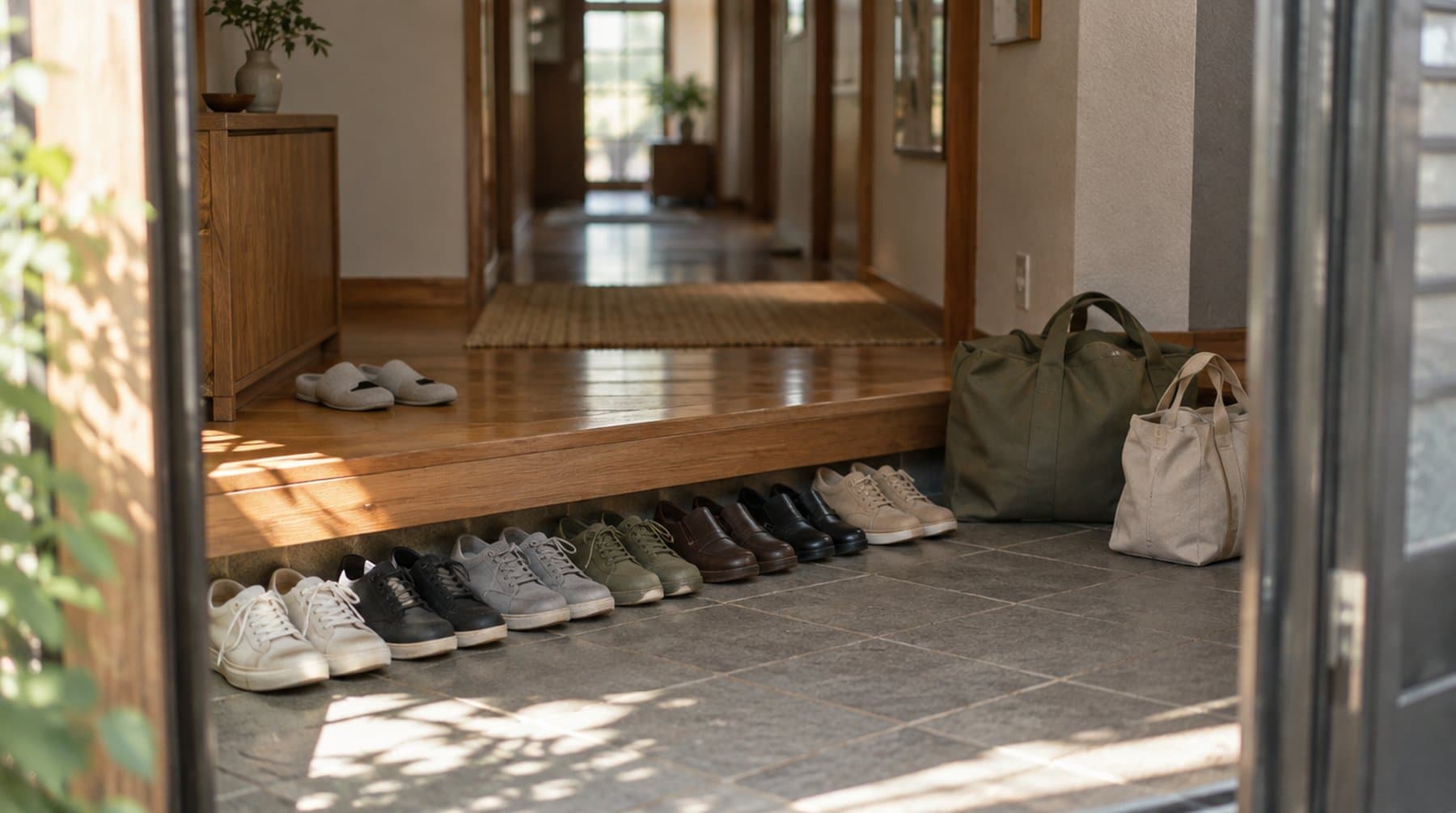
The mechanics are group-friendly. Check-in is self service from 16:00 with one door code for everyone, so the group does not have to arrive together or queue at a desk, and check-out is 11:00. Shoes come off at the genkan, and rubbish is sorted the way the ward sorts it, with collection days in the house manual. One person books, pays and holds the code; the other thirteen just turn up.
When should a group book?
Earlier than a couple would, because there is one house and it goes as a single unit. Across our own twelve months to July 2026 the Tokyo rooms averaged 85.4% occupancy, and the median gap between booking and arrival across all six of our rooms was 42 days (measured 21 August 2026, method at our published operating data). A couple can move their dates; a group of twelve with flights booked cannot, so two to three months out is the sensible window, and more for New Year, cherry blossom and the autumn weeks.
Book direct if you can. One booking, one payment and one receipt is easier when fourteen people split the cost afterwards, and you are talking to the person who runs the house rather than a platform's message relay; what else changes is in our guide to booking direct. If your group is a family of four or five rather than a party of twelve, start with the family apartment guide instead.
Check dates for the whole house