
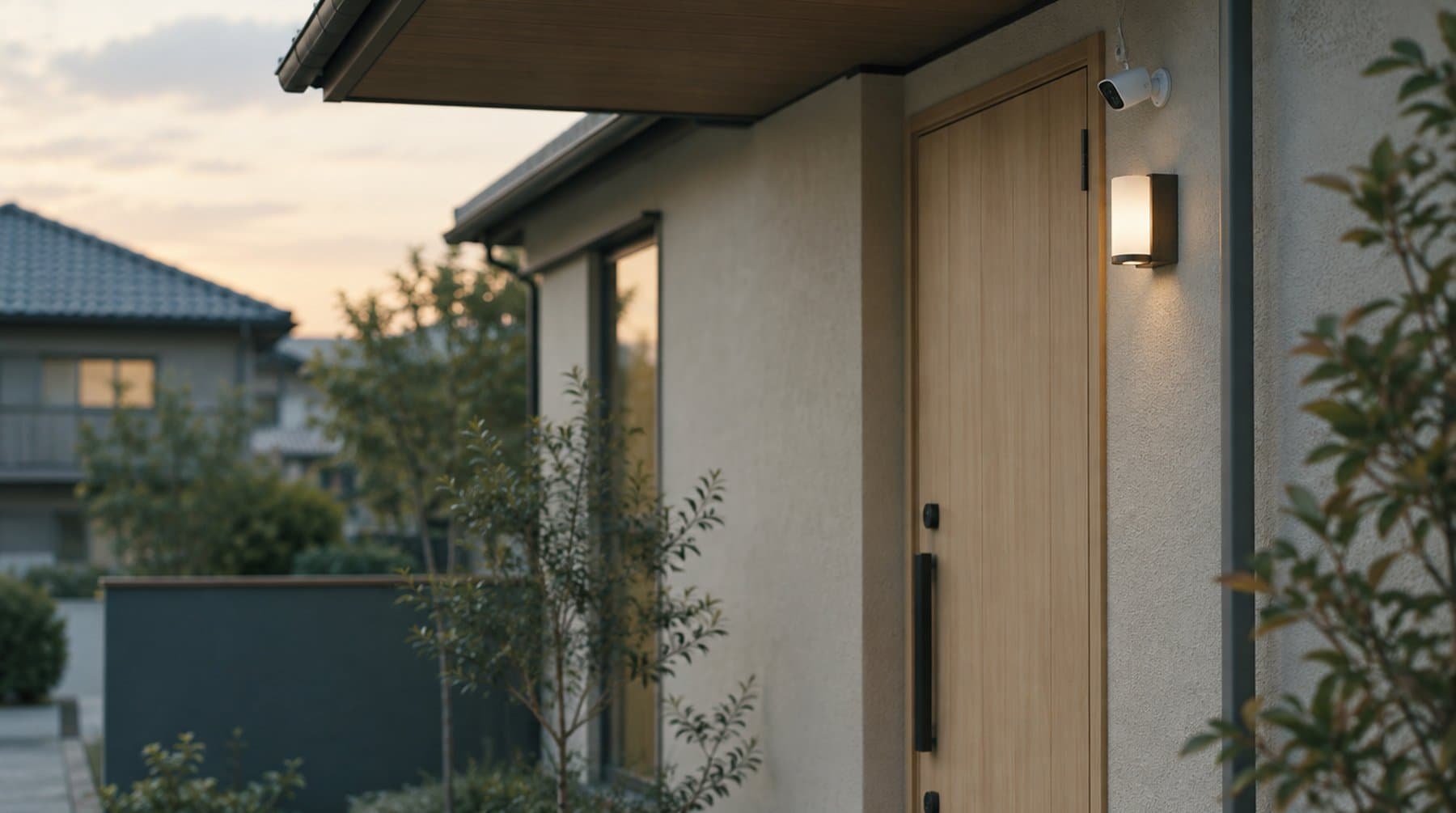
We keep two lines at our own rooms: no camera inside a room, and any device outside the door is written into the booking-site listing. We run three buildings and six rooms in Ota and Katsushika in Tokyo and Kita ward in Sapporo, all on hotel-business permits (ryokangyo permits, the licence a Japanese inn holds). Over twelve months they took 489 bookings at an average of 3.3 nights, so somebody new opens each door about seven times a month (measured 1 October 2026, for October 2025 to September 2026, published on our operating data page).
Nobody can watch that many arrivals by eye, so the question of devices always comes up. But where a device may go and what has to be said about it are settled before anyone chooses the hardware.
What do our six rooms actually have?
The only devices our listings mention are a security camera at the Kameari entrance and motion-sensor lights. The listings for the four rooms in Heiwajima and Sapporo mention no devices.
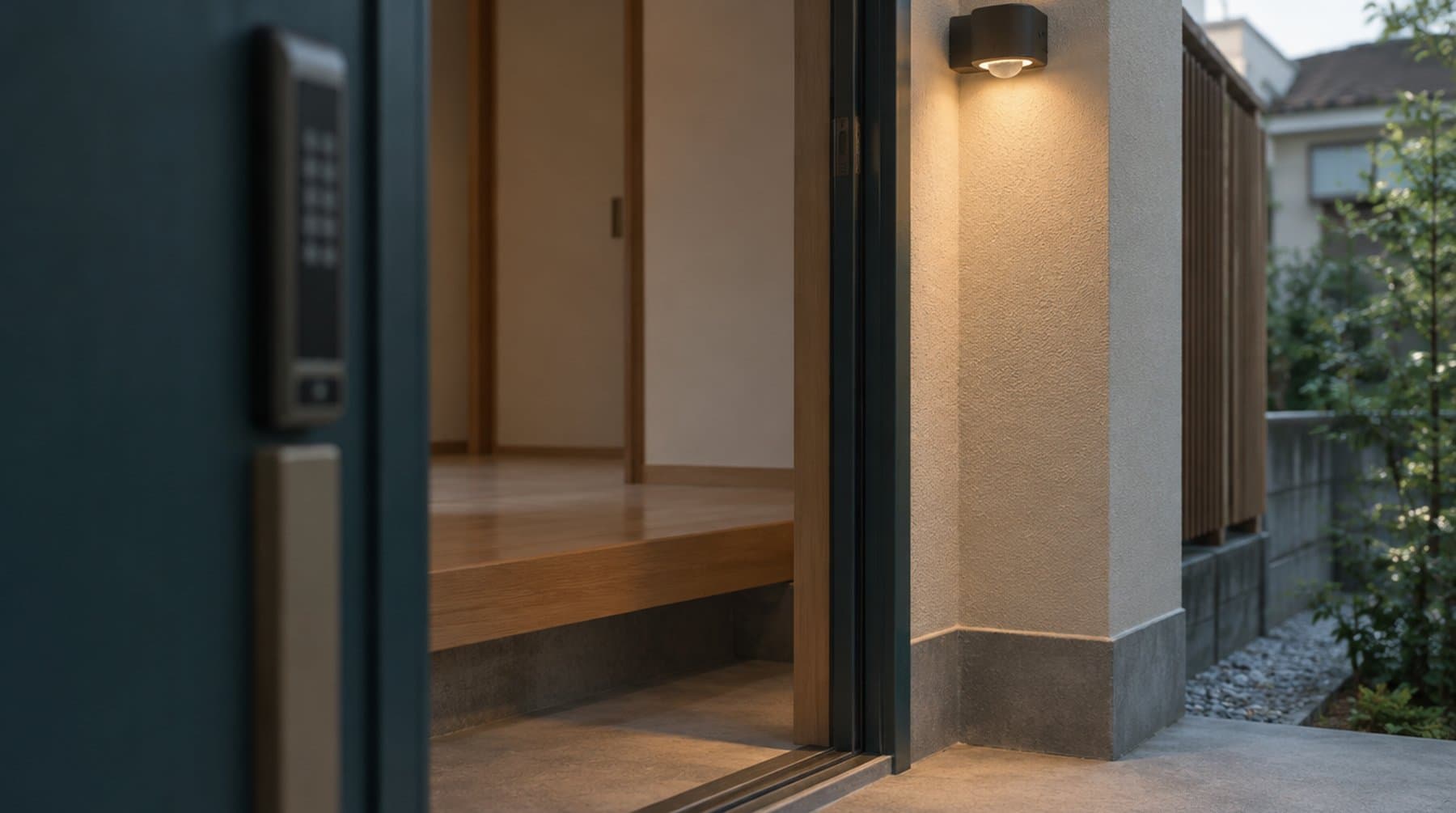
Kameari is a single building. The listing for unit 201 says "Security camera and motion-sensor lights at entrance"; the listing for 101 says "Motion-sensor lights at entrance". The light is there before it is security: it lets someone arriving at night find the lock. How the keys themselves work is in our piece on key handover and smart locks.
| Building | Outside the door | Inside the room | In the listing |
|---|---|---|---|
| KAMEARI 201 | Security camera, motion-sensor light | None | Both stated |
| KAMEARI 101 | Motion-sensor light | None | Light stated |
| HEIWAJIMA (1 room) | None listed | None | Nothing to state |
| SAPPORO NORTH (3 rooms) | None listed | None | Nothing to state |
Who decides, depending on where the device goes?
An "entrance" can belong to the whole building or to one unit, and the person who decides changes with it. This is not something a general rule can answer, so what we fix is the order of checks.
At a shared entrance, the building's management rules (kanri kiyaku) and the owners' association or landlord come first. Outside a unit's own door, read the booking sites' rules next: each platform sets conditions on where devices may be and how they must be disclosed, and those pages change, so read the current version before installing. How recorded footage must be handled is a question for a specialist, such as an administrative scrivener (gyoseishoshi) or a lawyer.
| Location | Check first | What we do |
|---|---|---|
| Shared building entrance | Management rules, association or landlord | Follow the building |
| Outside the unit's own door | Each booking site's current policy | If installed, state it in the listing |
| Inside the room | Not applicable | Never |
Will a noise sensor stop night-time complaints?
No. A sensor reports how loud it is, not who is doing what, and without a person who acts on the alert it only adds to a log.
For noise at night we rely on an order of response rather than a device. When a complaint or a sign of trouble arrives, the first call goes to the guests in the room, before anyone else; that is the sequence described in our piece on neighbour complaints. Our listings also state quiet hours of 9 PM to 7 AM, so guests read them before they book.
If we add a sensor, it will be to make that call happen sooner, and like the camera it will go into the listing.
A sensor can sometimes flag a problem before a neighbour does. Even then, it is a person who has to pick up the phone and call the room.
How do we word it in the listing?
Type of device and where it is, stated plainly. In the Kameari 201 listing it is one line in the amenities list: "Security camera and motion-sensor lights at entrance".
A line in the ordinary amenities list surprises nobody; small print somewhere else does. A guest discovering a device after booking is the outcome that costs the most in reviews. Ours stand at 398 reviews averaging 4.9 (measured 1 October 2026, operating data).
The house rules carry the rest: no parties or large gatherings, and if a neighbour or another guest complains about noise, guests may be asked to leave, even at night. Making what is not allowed readable before booking does more than any device placed after it.
Why nothing inside a room?
Because the room is the private space the guest has paid for, and a lens inside it costs more trust than it could ever protect.
What happens inside a room is covered by looking at it, not by watching it. Each room is turned over about seven times a month, and every turnover includes a check for damage and photographs taken after the work (see cleaning in practice). The most we leave in a living room is the house guide and a contact number.
Who looks at the footage, and when?
Before installing, decide three things: who may view, in what situation, and for how long recordings are kept. Install first and decide later, and the footage becomes a dispute about whose it is.
Limiting viewing to the moments when a fact about who came and went has to be established is the line that is easiest to explain to guests. When we fit a camera at an owner's property, we also settle up front who can see the footage and how the device and recordings are handed over if the contract ends.
What changes when an operator runs it for you?
Not the hardware. What changes is whether somebody acts when an alert arrives; a sensor or a camera is only useful with a response attached.
On the site visit we look at the entrance and the door first, then agree with the owner where a device may go, the line that goes into the listing, and how footage is handled. Our operating plan is 20% of revenue plus actual costs for cleaning, linen and supplies; buying and fitting devices is quoted separately.
We work in the Greater Tokyo area and Sapporo, Hokkaido; other areas on request. Where a property already has a camera or sensor, the first thing we check at handover is whether the listing describes the device that is actually there, in the place where it actually is.