
Across our own three buildings and six rooms, equipment and fittings repairs came to 1.0% of revenue over twelve months (October 2025 to September 2026, measured 1 October 2026, our own figures, published with the method at operating data).
That line is not small because the equipment is tough. Split the same twelve months by month and six of them are 0.0% while the largest is 4.7%. The question is never whether something will stop working. It is what happens in the hours after it does, and those hours set both the height of this line and the reviews for that month.
What actually happens when the Wi-Fi or the hot water stops?
The first move is not a repair, it is a message. In the minutes after a guest reports something, there are exactly two jobs: work out whether it can be restored remotely, and decide whether the room is still usable tonight.
The order of those checks is fixed per symptom, so nobody is improvising at midnight. Everything that can be done remotely is tried first, and someone travels only when that fails. First response runs around the clock and hands over to a person at the point where judgement is needed (whether a rental needs 24-hour guest response). All six of our rooms have air conditioning, heating, hot water and a washing machine, so every row below can happen in any of them.
| Symptom | Tried first, remotely | Does someone travel? |
|---|---|---|
| No Wi-Fi | Remote router restart, the carrier's outage notices, the guest's own device | Usually not |
| No hot water | Breaker and water-heater reset, walked through with photographs | Yes, if that does not restore it |
| Air conditioning not cooling | Settings and remote, filter, whether the outdoor unit is blocked | Often yes |
| Washing machine stopped | Reading the error display, drainage and the door lock | Usually not |
| Front door will not open | Reissue the entry code, check battery level | Yes if it is the battery (three buildings, three key methods) |
What decides how long a repair takes?
Whether the part is already inside the building. The contractor's diary comes second.
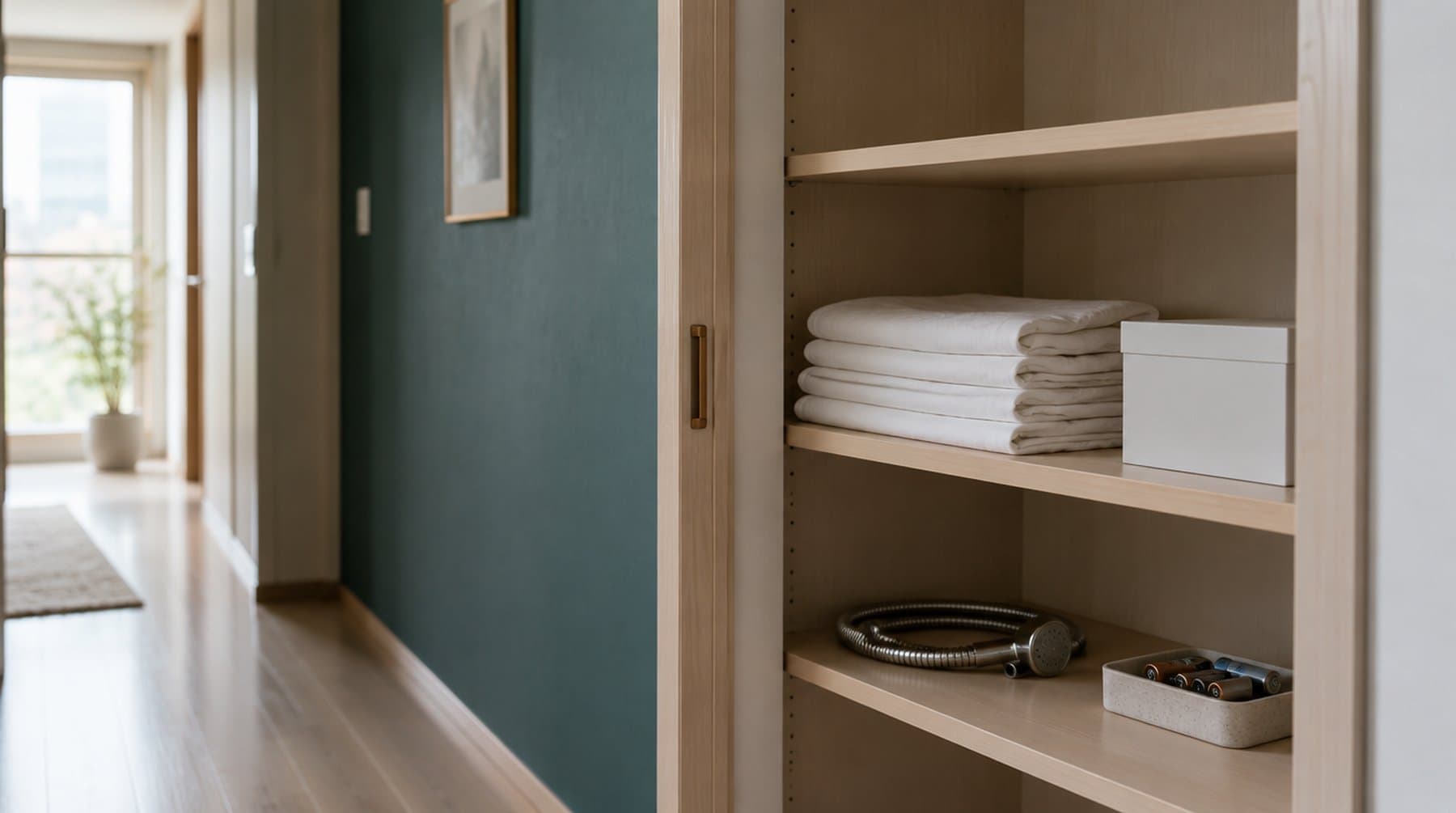
Call a contractor and the earliest is usually the next day, and in the busy season several days out. If the air conditioning fails in a Tokyo August or the water heater fails in a Sapporo February, those days are nights the room cannot be sold. So what we keep in each building is only what can be swapped in five minutes and does not spoil in storage: a spare router, bulbs, smart-lock batteries, a shower head and hose, an extension lead, a full set of linen. A spare water heater or air conditioner cannot be kept on a shelf, so that gap is covered by how long we have worked with the same contractors rather than by stock.
The other resource is time. Checkout is 11:00 and check-in is 16:00, which leaves a five-hour window (10:00 at one unit), and most of it belongs to the changeover clean. Anything over half an hour therefore waits for a day with no arrival, and at 83.7% occupancy a room has only about five such nights a month. Scheduling repairs is a competition for those five nights.
Why do repairs stay at 1.0% of revenue?
Because somebody is inside each room seven to eight times a month.
Cleaning is 17.0% of revenue, the largest line in our operating costs (the full cost breakdown), which is seventeen times the repair line. The two look like separate costs and are really one mechanism seen twice. At 83.7% occupancy and an average stay of 3.3 nights a room turns over seven to eight times a month, and each changeover puts a person in front of a noise that is not yet a failure or a water mark that is not yet a leak. Deciding to make cleaning cheaper is also deciding to inspect less often (how the cleaning runs).
| Month | Equipment and fittings repairs, share of revenue |
|---|---|
| October 2025 | 1.2% |
| November 2025 | 1.5% |
| December 2025 | 1.4% |
| January 2026 | 2.2% |
| February 2026 | 4.7% |
| March 2026 | 0.0% |
| April 2026 | 0.0% |
| May 2026 | 0.0% |
| June 2026 | 0.0% |
| July 2026 | 0.0% |
| August 2026 | 1.3% |
| September 2026 | 0.0% |
What operating data publishes is the twelve-month total; the rows above are the same window split by month from the books. The six months that carried any spend were October 2025 through February 2026, plus August 2026, which is the heating load and the peak of the cooling load. The six months at 0.0% were March through July and September, the mild ones.
Six rooms over twelve months cannot prove a cause. They are enough to time an inspection, though, so we look at the air conditioning before June and at the heating and hot water before October. In Sapporo the effort and the money land not in February, when the snow is deepest, but in November, when the building is made ready for it (winter in snow country). The separate question of when replacement peaks arrive is in furnishing a rental.
When is the guest told, and what are they told?
Before it is fixed. Even with no estimate for when it will be working, the message goes out with the not-knowing in it.
Three things belong in it: what cannot be used, the time of the next message, and the substitute for the gap between them. A night without hot water means the nearest sento, the neighbourhood public bath, which most Japanese residential districts still have. A dead washing machine means the nearest coin laundry. Failed air conditioning means a fan carried in. When there is no substitute to offer, the conversation moves to another room or a shortened stay.
On money, this article promises nothing. Whether a refund, a partial refund or the cost of a move falls to the owner, the operator or an insurer depends on three documents: the booking platform's policy, the management contract and the insurance cover. The places to read are the contract and the policy schedule (reading a management contract, insurance at a Japanese rental). Settle it in advance or it gets settled at two in the morning.
A rating drops not because something broke but because nobody wrote. That sentence is judgement from running six rooms, not a figure we counted: a review that records a fault handled is not the same star as a review that records being ignored (guest ratings).

Can a replacement touch the permit or require a notification?
We treat a like-for-like swap and a change of specification as two different things.
There is no table here, because the conditions differ by building and by municipality and a published table is out of date the day it goes up. What we do instead is telephone before a change of specification, not after. Plumbing and ventilation go to the relevant section of the public health centre, the hokenjo; extinguishers, alarms and emergency lighting go to the inspection contractor and the fire service (fire inspections after opening). Work that touches a condition of the permit itself is checked at the drawing stage (how a hotel-business permit is obtained).
Doing it in the other order is expensive. Ask after the work is finished and you may be taking apart what you just paid to build.
What should I ask a management company about equipment?
Four questions. Each has exactly one answer, and vague answers mean nobody there has worked a night like this.
- If the hot water stops at eleven at night, who does what, in what order? Make them say the sequence out loud. "We will deal with it immediately" is not a sequence.
- What spares are kept in the building? A company that keeps none waits for a contractor every time.
- Over the last twelve months, how many guests were moved because of equipment, and who paid for the move?
- Who can authorise a repair, and up to what amount without asking? And above that amount, who decides, and how fast?
The last one is worth writing into the contract. With no ceiling agreed, nothing starts until somebody answers the phone in the middle of the night. In our own fee structure, linen, supplies and repairs are passed through at cost with no markup (how our fee works). An arrangement that earns the manager a margin on repairs mixes the decision to fix with the decision to earn.
Does this 1.0% apply to my property?
No. A repair ratio is the result of the age of the building and the age of the equipment in it, and the same building reads differently in year one and year ten of a fit-out. Our own three buildings are of different ages.
What we can give an owner is not a future ratio but a measured one every month. The cost lines are handed over as they are, with what stopped working, who attended and where the money went (what belongs in the monthly report). We promise no occupancy figure and no repair figure.